
railway-international.com
12
'26
Written on Modified on
Air-Free Rail Brake Systems
Knorr-Bremse, Siemens Mobility, and Liebherr Transportation deploy brake-by-wire solutions to eliminate pneumatic piping, valves, and compressors in rail transit fleets.
induportals-media-publishing.com
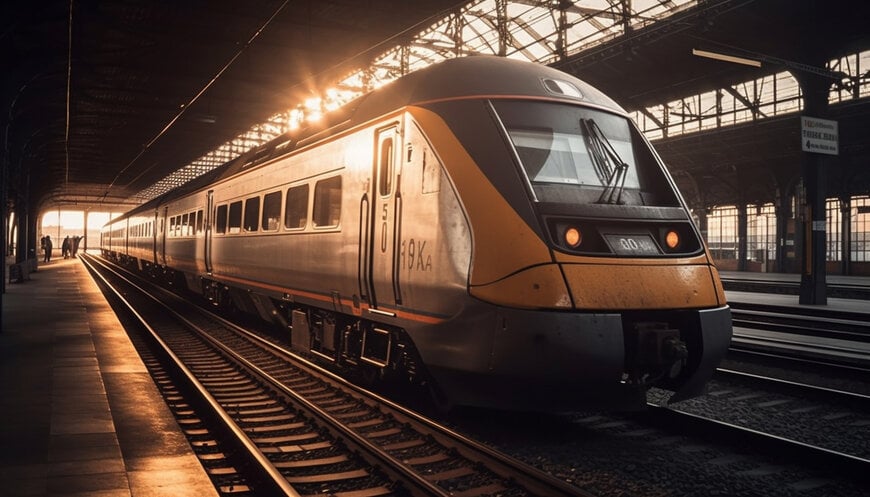
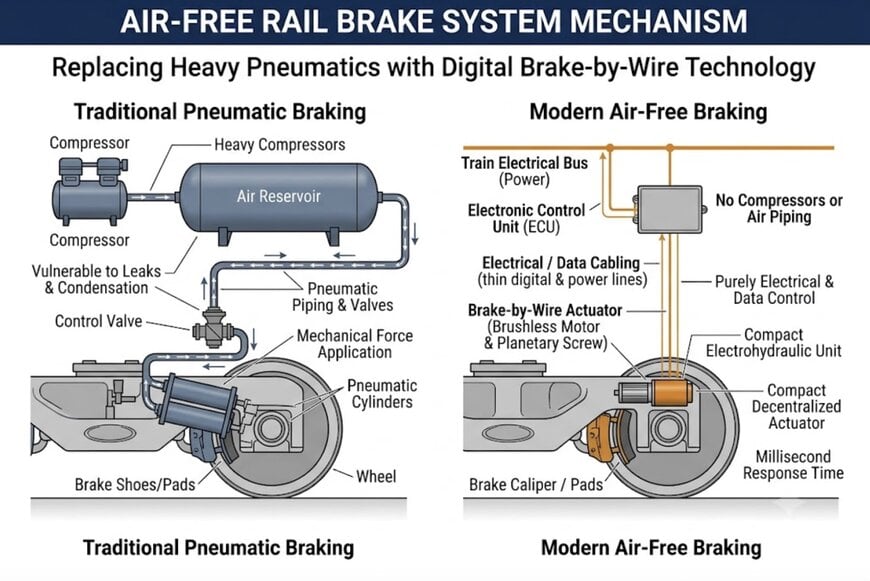
For over a century, trains have relied on compressed air to stop. Traditional pneumatic brakes work through complex networks of air compressors, heavy storage tanks, and metal pipes running beneath every carriage. Modern air-free braking—often called brake-by-wire—replaces this heavy air equipment with digital electronics. Instead of pumping pressurized air through pipes to push brake pads against train wheels, computer control units send instant electrical signals straight to compact motorized actuators located directly at the wheels. This transition cuts hundreds of kilograms of vehicle weight, eliminates air leaks and frozen moisture in cold weather, and enables significantly faster, smoother, and more energy-efficient stops.
Current Technology Market Landscape
Traditional pneumatic trains demand substantial energy to generate and treat compressed air, which is vulnerable to condensation, seal degradation, and thermal loss. The air-free brake paradigm replaces this setup with digital actuators powered directly by the train electrical bus. Siemens Mobility documentation records vehicle brake equipment weight savings between 25% and 40%, accompanied by an underfloor volume reduction and over 50% decrease in lifecycle carbon-equivalent metrics. System actuation signals interface over high-integrity CAN bus architectures, shortening cold-train startup readiness from over twenty minutes down to less than four minutes.
Core Market Challenge
The engineering hurdle centers on achieving fail-safe stopping without pneumatic reservoir redundancy. Legacy fail-safe braking relies on spring accumulators released by line pressure; venting line air automatically halts the train. Purely electrical and electrohydraulic systems must match strict Safety Integrity Level 4 (SIL 4) requirements using redundant power supplies, decentralised energy backup units, and fail-closed mechanical clamps. Furthermore, retrofitting depots accustomed to pneumatic valves requires substantial upskilling of technical maintenance teams.
Solutions Compared: Existing Technology Solutions
Knorr-Bremse utilizes a fully dry, digital electromechanical brake (EMB) mechanism. Its design relies on brushless motor actuators and mechanical planetary screw transmissions, completely eliminating fluid to deliver millisecond-level clamping response.
Siemens Mobility developed its Air-Free Brake system using decentralized, closed-loop electrohydraulic actuators co-engineered with Liebherr Transportation. This hybrid architecture keeps high-pressure hydraulic fluid hermetically sealed inside the actuator unit itself, utilizing an integrated electric pump without external plumbing.
Liebherr Transportation acts as the core precision actuator specialist, providing self-contained, sealed electrohydraulic brake units designed to fit inside standard bogie envelopes. These actuators withstand standard track vibrations of 50 m/s² and maintain 100% mechanical backward compatibility with legacy brake caliper spaces.
Actual Implementation on the Ground
Commercial operations demonstrate these systems in active passenger transit:
Siemens Mobility and Liebherr deployed their co-developed air-free brake actuators across Wiener Linien's X-Wagen trainsets on the Vienna U-Bahn, successfully running driverless passenger operations without compressed air supply.
Knorr-Bremse deployed its digital electromechanical braking system on Trenitalia passenger trains and within the Europe's Rail Joint Undertaking testing program, verifying dry-caliper friction performance and wheel slide protection across variable wheel-rail adhesion profiles.
Summary and Strategic Future Outlook
Brake-by-wire platforms redefine modern rolling stock architecture by removing pneumatic infrastructure, lowering unsprung mass, and enhancing wheel slide control. While Siemens and Liebherr have demonstrated passenger operations using hermetic electrohydraulics, Knorr-Bremse continues pushing dry electromechanical actuation toward mass fleet standardization across global transit systems.
Edited by Romila DSilva, Induportals Editor, with AI assistance.
