
Delivering Uniformity Across 102 Metres
The new Mountfleurie Bridge has officially opened to the public, creating a vital pedestrian connection across the reinstated rail corridor forming part of the Levenmouth Rail Link.
ivisionuk.com
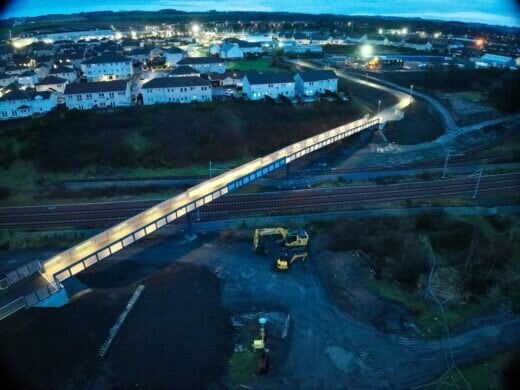
© I-Vision Lighting Solutions
Commissioned by Fife Council, delivered via Network Rail, and constructed by Story Contracting, the 102-metre bridge strengthens connectivity within Levenmouth while supporting active travel and wider regeneration objectives.
Lighting such a structure required a solution that balanced visual performance, capital efficiency and environmental sensitivity.
The Challenge of a Long Linear Structure
At 102 metres in length and 4 metres in width, Mountfleurie Bridge is long by UK rail footbridge standards. With luminaires mounted at 1.4 metres above finished floor level, the system needed to deliver consistent deck illumination across the full span while avoiding unnecessary spill into the surrounding semi-rural landscape.
Although the site is not subject to formal dark-sky designation, its context informed the specification. A warmer 3000 K colour temperature was selected to reduce visual harshness and integrate more sympathetically with the environment.
Long-span pedestrian bridges frequently default to continuous linear lighting along both sides of the walkway. While effective in achieving uniformity, this approach can significantly increase installed length, capital cost and connected electrical load.
A Staggered, Interleaved Approach
Rather than adopting a continuous installation, i-vision worked in collaboration with lighting designer Euan Clayton and the wider project team to develop a more efficient configuration.
The final arrangement comprised:
. 2-metre runs of i-vision Elektra 1712 linear luminaires positioned at six-metre intervals
. Alternating installation between each side of the 4-metre deck, resulting in a luminaire every three metres along the span
. Photometric modelling to ensure blending between adjacent runs
Three lighting simulations were undertaken during RIBA Stage 4 to validate the concept.
The resulting staggered, interleaved layout achieves visual continuity across the full 102-metre span without continuous physical installation.
Technical Performance
The installed lighting system comprises:
. Luminaire: i-vision Elektra 1712
. Wattage per 2-metre section: 2.5 W
. Total annual energy consumption: 573 kWh
. Optics: Asymmetric distribution
. Colour temperature: 3000 K
. CRI: >85
. Impact resistance: IK10
. Ingress protection: IP66
. Design life: L90 30,000 hours
Control is achieved via a timed system integrated with a photocell.
Light spill modelling confirmed that illumination measured 1 metre from the bridge did not exceed 1 lux, limiting impact on the surrounding environment.
Early Engagement and Collaborative Design
i-vision was engaged at RIBA Stage 4, enabling lighting modelling to inform detailing prior to installation.
Through three modelling iterations, the team refined luminaire spacing, optical blending and mounting geometry to ensure:
. Consistent deck illumination along the full span
. Controlled spill beyond the bridge structure
. Clean integration within the structural design
. Reduced installed material without compromising visual continuity
As a result, the scheme demonstrates how early collaboration between designer, contractor and specialist supplier can unlock measurable efficiencies.
Euan Clayton, Director at Clayton Lighting & Traffic Ltd, commented:
“Lighting was incorporated discretely into the bridge structure, in order to provide sufficient and controlled illumination for the public, whilst being sensitive to the wider environment and minimising the risk of light pollution and the risk of vandalism”
A Model for Future Rail Footbridge Schemes
As rail and local authorities invest in active travel infrastructure, pedestrian bridges must perform consistently after dark while remaining financially responsible to deliver.
Mountfleurie Bridge illustrates that intelligent photometric strategy — rather than default continuous installation — can significantly reduce material quantity, improve installation efficiency and maintain visual consistency across long spans.
For asset owners operating within constrained capital budgets, this collaborative and performance-led approach provides a scalable model for future rail footbridge projects across the UK.
By Geoff Jones, Director, i-vision Lighting Solutions Limited
www.ivisionuk.com
