
railway-international.com
23
'26
Written on Modified on
Intelligent Monitoring Transforms Railway Turnout Maintenance
voestalpine Signaling Austria advances multi-sensor and data-driven monitoring systems to improve turnout reliability, predictive maintenance, and lifecycle cost efficiency.
www.voestalpine.com
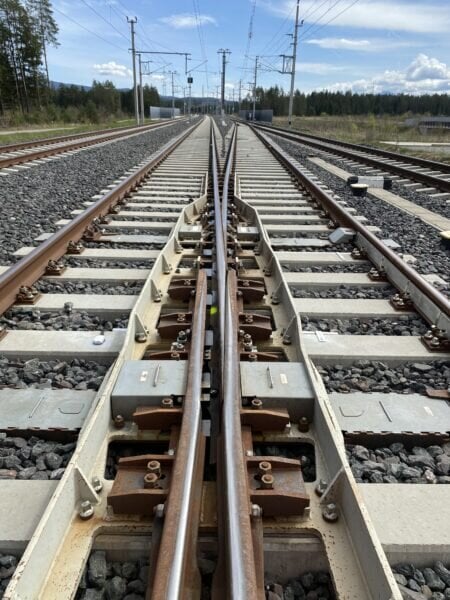
Modern railway networks are increasingly adopting intelligent infrastructure monitoring to improve safety, availability, and cost efficiency. By combining sensor data with advanced analytics, operators can detect early signs of wear or failure in critical assets such as turnouts, enabling predictive maintenance and reducing unplanned downtime.
Multi-Sensor Monitoring of Critical Assets
Turnouts are among the most complex and maintenance-intensive components in rail infrastructure. Monitoring systems deploy a range of sensors across key elements such as switch rails, crossings, and sleepers to capture vibrations, accelerations, and acoustic emissions during train passages.
Additional sensors—such as current transducers, pressure, temperature, humidity, and inductive devices—are used to monitor switch operation depending on the type of point machine. These measurements provide a comprehensive view of asset condition under real operating loads.
voestalpine Railway Systems has implemented such technologies within its zentrak portfolio, combining multi-sensor arrays with laser-based geometry scans to validate degradation models and improve diagnostic accuracy.
Modular Architecture for Diverse Rail Environments
Railway infrastructure varies significantly in geometry, materials, and operational conditions. Monitoring systems must therefore be adaptable to different track configurations, traffic patterns, and environmental influences.
A modular architecture allows systems to be tailored to specific requirements, including sensor placement and algorithm selection. Factors such as train speed, axle load, and track design influence both data acquisition and analysis methods, ensuring relevant and accurate condition assessment across diverse networks.
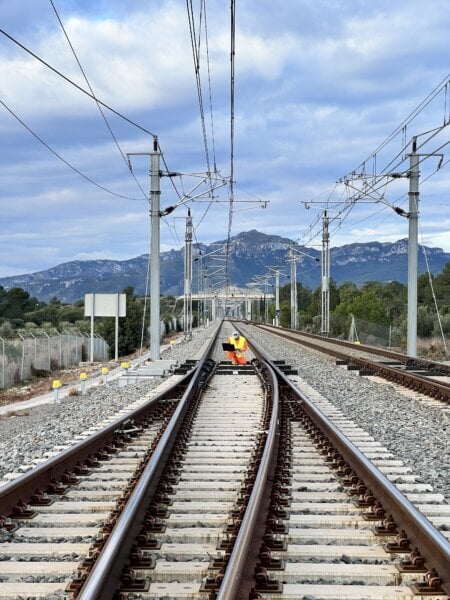
Mixed traffic turnout equipped with monitoring for ballast quality, crossing wear and switch rail monitoring. © voestalpine Railway Systems
Data Processing and Quality Assurance
Raw sensor data must undergo rigorous preprocessing to ensure reliability. This includes filtering noise, validating signals, and harmonising data from multiple sources such as wayside sensors, rolling stock telemetry, and inspection reports.
Feature extraction—such as identifying signal amplitudes or statistical properties—reduces data volume while preserving key information for analysis. High-quality data is essential for accurate health assessment and effective visualisation of asset condition.
Algorithm Strategies for Condition Assessment
The choice of analytical approach depends on data availability and system objectives. Data-driven models, including machine learning, are effective when large volumes of labelled data are available, supporting anomaly detection and trend prediction.
Physics-based models are applied where mechanical behavior must be explicitly represented, such as in stress analysis or turnout geometry evaluation. Hybrid approaches combine both methods, balancing interpretability with predictive performance.
In practice, many monitoring applications rely on a combination of techniques, including simple rule-based algorithms for straightforward tasks and more advanced models for complex diagnostics.
The Challenge of Ground Truth
A critical aspect of infrastructure monitoring is establishing reliable ground truth data for validating predictions. This information typically comes from inspection reports, measurement trains, and maintenance records, which may vary in format and quality.
Manual data collection under challenging field conditions can lead to inconsistencies, affecting the accuracy of validation processes. Integrating these heterogeneous data sources requires standardized formats, data fusion techniques, and improved documentation practices.
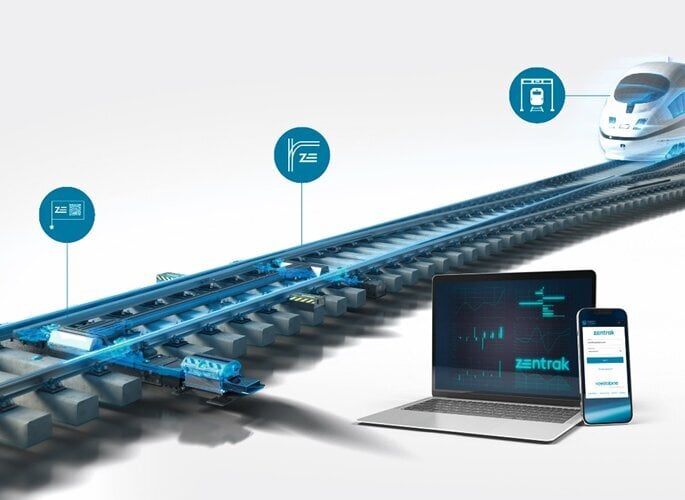
zentrak ecosystem with asset management & maintenance management, infrastructure monitoring and rolling stock monitoring module. © voestalpine Railway Systems
Data Storage and System Architecture
Decisions regarding data storage—whether on-premise or cloud-based—depend on regulatory requirements, cybersecurity considerations, and operational needs. On-premise systems offer greater control and compliance with strict regulations, while cloud solutions provide scalability and easier integration with analytics tools.
Hybrid architectures are increasingly adopted, combining local control with cloud-based processing to balance performance, accessibility, and compliance.
Closing the Loop: From Data to Action
For monitoring systems to deliver value, insights must be integrated into maintenance workflows. This includes linking condition data with asset management systems, prioritizing alerts, and enabling timely interventions.
Demonstrator projects have shown that integrating monitoring platforms with maintenance systems can reduce track possession times, optimize maintenance intervals, and improve asset availability. Continuous feedback from maintenance activities further refines predictive models, enhancing long-term accuracy.
Relevance for Digital Railway Systems
Intelligent monitoring systems are a key component of modern railway digitalisation strategies. By combining sensors, analytics, and integrated platforms, operators can transition from reactive maintenance to predictive, data-driven approaches.
Such systems support a more resilient digital supply chain for rail infrastructure, enabling improved asset lifecycle management, reduced operational costs, and enhanced service reliability.
Article by Dino Velic, R&D Project Manager Intelligent Turnout at voestalpine Signaling Austria GmbH; edited with AI assitance.
Article by Dino Velic, R&D Project Manager Intelligent Turnout at voestalpine Signaling Austria GmbH; edited with AI assitance.
www.voestalpine.com
