
railway-international.com
07
'26
Written on Modified on
Static Charging Collector Enables High-Current Tram Electrification
Mersen develops high-current static collector technology for ground-based tram charging, supporting catenary-free urban transport and short-duration energy transfer.
www.mersen.com
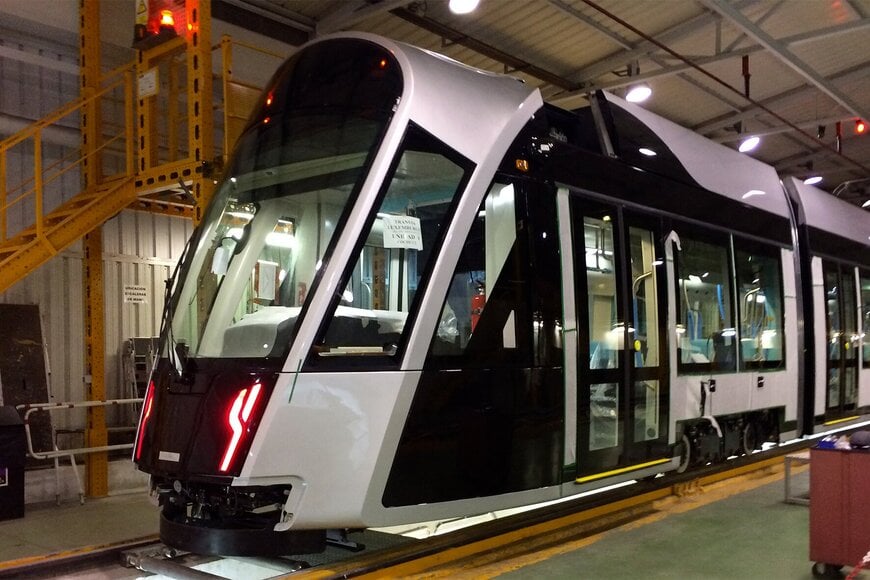
Model of Luxembourg tram © Mersen
Mersen has developed a static charging collector system for tramways, enabling high-power energy transfer from ground-based infrastructure to onboard storage systems. The technology supports catenary-free operation in urban environments where overhead lines are restricted for aesthetic or planning reasons.
Transition from overhead lines to ground-based systems
Traditional tram systems rely on overhead catenary lines for continuous power supply. While technically effective, these systems can conflict with urban design requirements, particularly in historic or protected areas.
Ground-based power systems provide an alternative by transferring energy at specific points along the route, eliminating the need for continuous overhead infrastructure. Early developments included dynamic third-rail systems, while more recent approaches combine onboard energy storage with stationary charging at stops.
Static charging architecture and operation
In static charging systems, a conductive rail is embedded at designated stations and is only energized when a tram is correctly positioned. A communication interface ensures safe activation under controlled conditions.
Once stationary, the tram deploys a collector to connect with the ground rail. During passenger boarding and alighting, electrical energy is transferred to onboard storage systems within a short time window before the collector retracts and the vehicle resumes operation.
High-current transfer and engineering requirements
Unlike dynamic current collection, static charging requires the transfer of high current in a limited time. Mersen’s latest collector design supports current levels of up to approximately 1,600 A within charging cycles of around 20 seconds.
This necessitates:
- Low contact resistance for efficient power transfer
- High thermal stability to manage rapid heat generation
- Mechanical precision to maintain consistent contact pressure
The collector design evolved from earlier systems rated at approximately 800 A, reflecting increasing power demands from advanced onboard energy storage systems such as supercapacitors.
Simulation-driven design and validation
To optimize performance, Mersen applied multiphysics simulation tools to model electrical conduction and thermal behavior. This enabled analysis of:
- Current density distribution
- Contact interface behavior
- Heat generation and dissipation
Laboratory validation was conducted using dedicated test benches to evaluate electrical, mechanical, and durability performance prior to field deployment.
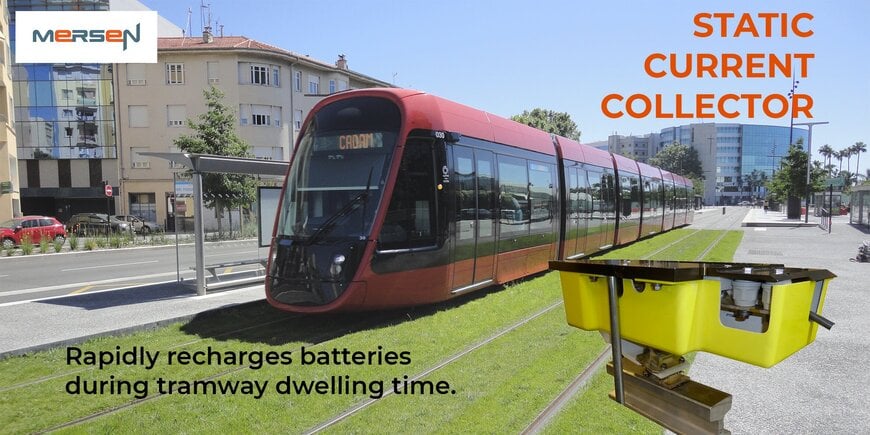
Mersen static current collector © Mersen
Operational reliability under real conditions
Field operation introduced additional considerations, including micro-movements of the tram caused by passenger activity. These small displacements can affect contact pressure and lead to issues such as micro-arcing or wear at high current levels.
Through iterative design refinement and on-site validation, the collector geometry and materials were optimized to ensure stable performance under real operating conditions.
Deployment and application context
Static charging systems are deployed in multiple urban tram networks, including installations in Europe and Australia. They are particularly suited to environments where visual impact must be minimized, such as historic city centers and tourism-sensitive locations.
Projects such as the tram system in AlUla, Saudi Arabia, demonstrate the application of this technology in areas requiring both high-performance transport and preservation of the surrounding landscape.
Role in modern rail electrification
Static charging collectors are a key component of integrated tram electrification systems, combining infrastructure, vehicle systems, and control interfaces. Their development reflects broader trends in rail electrification toward:
- Reduced infrastructure footprint
- Integration with onboard energy storage
- Flexible charging strategies
As energy storage and power electronics continue to advance, such systems are expected to play an increasing role in urban rail transport modernization.
Edited with AI assistance.
www.mersen.com
