
railway-international.com
09
'26
Written on Modified on
Rotating Frame Intermodal Railcars for Automated Container Handling
GATX Rail Europe has developed an adapted Sggmrss railcar featuring rotating frames to support flexible waste and industrial logistics within the digital supply chain.
www.gatx.eu
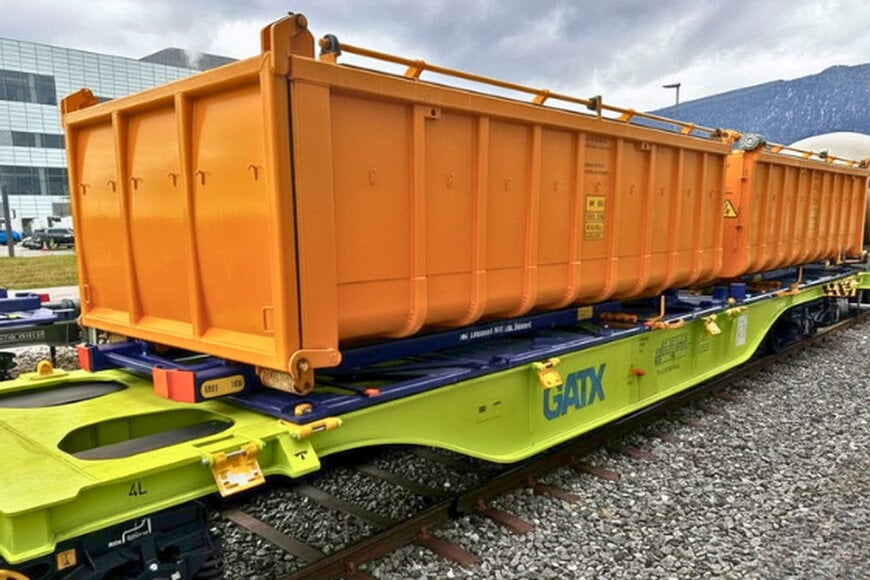
The implementation of adapted Abroll-Container-Transport-System (ACTS) railcars provides a modular platform for the multimodal transport of bulk materials, specifically targeting the waste management and industrial sectors. By integrating horizontal and vertical handling capabilities, this technology enables rail freight to interface with truck-based loading systems without the requirement for stationary crane infrastructure.
Technical Architecture and Load Parameters
The system utilizes a modified Sggmrss chassis equipped with four independent rotating frames or plates. These mechanical interfaces allow for the secure mounting of 5.95-meter ACTS containers or 20-foot hybrid ACTS ISO containers. The technical specifications of the railcar platform include a total loading weight of 107,100 kg, with each of the four rotating plates weighing approximately 2,800 kg.
The design supports a gross weight of up to 20,000 kg per container. This capacity is optimized for light bulk materials, such as wood chips and municipal waste, which require high-volume transport solutions but often originate from facilities lacking specialized rail-to-road transshipment hardware.
Operational Flexibility and Handling Mechanisms
The primary innovation of this railcar type lies in the rotating frame concept, which facilitates two distinct unloading methodologies:
- Horizontal Transshipment: The frame rotates outward to allow truck-based hydraulic systems to pull containers directly from the railcar onto a road vehicle. This mechanism eliminates the need for reach stackers or gantry cranes at the point of origin or destination.
- Vertical Transshipment: For locations equipped with traditional intermodal infrastructure, the 20-foot hybrid ACTS ISO containers remain compatible with standard vertical lifting via crane or reach stacker.
This dual-mode capability addresses a critical bottleneck in the automotive data ecosystem and industrial logistics: the "last mile" connectivity between rail sidings and processing plants. During the "Waste on Rail" initiative, the solution completed operational test runs transporting material to an incineration plant, confirming the stability of the rotating mechanism under standard rail freight vibrations and stresses.
Strategic Deployment and Iterative Development
Johannes Frieß, Head of Fleet Management at GATX Rail Europe, states that the adapted railcar type enhances the intermodal portfolio by providing a modular solution that maintains equipment robustness while enabling diverse loading concepts.
Following the initial pilot phase, the rotating frame hardware is undergoing further refinement to optimize the weight-to-load ratio and improve the speed of the mechanical rotation. Additional test applications are scheduled to validate the system across a wider range of industrial use cases beyond waste management, ensuring the technology meets the rigorous duty cycles required for pan-European freight corridors. The scalability of the solution remains tied to the ongoing development of regional regulatory frameworks regarding multimodal waste transport.
Edited by Evgeny Churilov, Induportals Media - Adapted by AI.
www.gatx.eu
Strategic Deployment and Iterative Development
Johannes Frieß, Head of Fleet Management at GATX Rail Europe, states that the adapted railcar type enhances the intermodal portfolio by providing a modular solution that maintains equipment robustness while enabling diverse loading concepts.
Following the initial pilot phase, the rotating frame hardware is undergoing further refinement to optimize the weight-to-load ratio and improve the speed of the mechanical rotation. Additional test applications are scheduled to validate the system across a wider range of industrial use cases beyond waste management, ensuring the technology meets the rigorous duty cycles required for pan-European freight corridors. The scalability of the solution remains tied to the ongoing development of regional regulatory frameworks regarding multimodal waste transport.
Edited by Evgeny Churilov, Induportals Media - Adapted by AI.
www.gatx.eu
