
railway-international.com
15
'26
Written on Modified on
Digitalization on the Railway
As rail demand grows, digitalisation is key to boosting capacity, safety and predictive maintenance.
www.voestalpine.com
More and more people and goods are to be transported by rail in the future. As a result, the rail network is increasingly reaching its limits. How can rail remain an attractive part of the transport chain in the future? Sandra Baltic, Product Manager at voestalpine Railway Systems, discusses the role of digitalization in increasing availability, safety, and predictive.
How Does Digitalization Change the Monitoring of Track Systems and the Strategies for Predictive Maintenance?
Sandra Baltic, Product Manager at voestalpine Railway Systems said:
"Digitalization makes track systems completely transparent. Using technologies like RFID (Radio Frequency Identification), we can precisely identify and locate each rail and track its condition throughout its entire lifespan. This, in turn, enables data-driven decisions, early warnings before reaching relevant infrastructure limits, and predictive maintenance. As a result, costs decrease and availability increases."
What Functions Do RFID Tags and Sensor Technologies Perform in Capturing Performance and Lifecycle Data?
RFID tags provide the unique identity of each rail. Sensors, on the other hand, provide insights into the track’s condition. Together, they enable seamless traceability and the recording of relevant track parameters. This data forms the basis for a digital twin, which shows how each rail develops under real operating conditions and when maintenance is truly necessary.
If customers want to understand the condition of their tracks in detail, we use targeted measurement technology from various data sources.
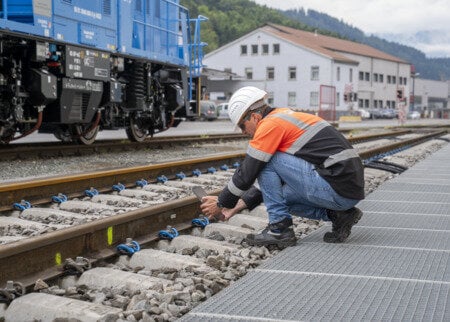
For example, our newly developed measuring railcar can be used for a comprehensive analysis of track condition. It offers the advantage that a single measurement run continuously records all relevant track parameters. To record track stress during operation, we install track measuring stations that can detect stress-relevant patterns that will lead to damage in the long term. This gives operators a complete picture of the actual track condition and its changes. This allows customers to identify critical developments early on and take targeted action to mitigate them.
How Can Track Performance Be Accessed Digitally?
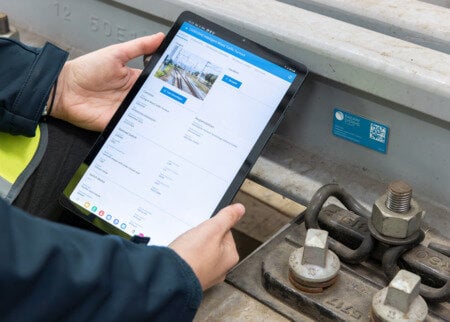
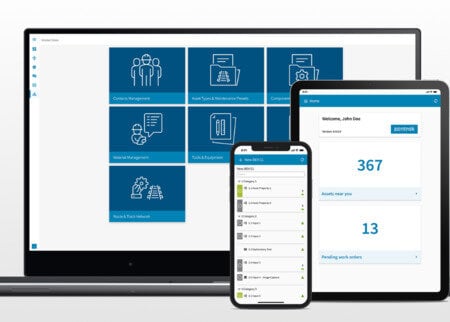
With our zentrak platform, infrastructure operators receive a central solution that consistently consolidates all relevant lifecycle information—from manufacturing and installation data to load and condition data, right up to end-of-life information. This is based on tags with a data matrix code and an integrated RFID function, which are attached directly to the rails. On the track, technicians can scan the data matrix code with a smartphone or tablet using the app, gaining immediate access to the associated master data. This allows maintenance work or anomalies to be documented directly and digitally.
During operation, the RFID function enables automated reading of the tags via an on-board reader, for example, on a rail vehicle or measuring vehicle. This allows for fully automated data transfer. The read RFID number and GPS position, for instance, are linked to the master data and transferred to Zentrak, where further measurement data can be added and interpreted. This creates a virtual track network in which every component is seamlessly traceable throughout its entire lifecycle and its performance can be measured. This forms the basis for complete transparency and data-driven, collaborative asset.
What Are the Advantages of Digitally Locating Components on the Track?
Only after each component has been clearly identified and precisely located can the virtual mapping of the track network begin and an automated link to track condition data be established. For example, if wear or RCF data are referenced to a precisely located component, accurate condition profiles are generated. This makes performance measurable not only track-wise, but also at the component level.
By consolidating all track data in a single digital system, all stakeholders can see at a glance which components are installed where, their history, and their performance. For customers, this offers the opportunity for performance comparisons, performance-based component selection, planned track maintenance, and increased network availability. Centrally stored performance data allows patterns and trends to be identified, enabling the identification of the causes of recurring track damage and the implementation of targeted countermeasures – instead of costly replacements.
What Approach Does voestalpine Railway Systems Take to the Digitalization of Track Systems?
We pursue a holistic, system-oriented approach to the digitalization of track systems. A key advantage is that, as a complete system provider, we supply not only rails but also other track superstructure components, enabling us to consistently map all track components digitally within a single system – zenrak.
When components come from different manufacturers, centralized data management is often difficult. However, our systems expertise allows us to centrally capture, network, and consolidate all information in a digital structure. zentrak enables us to translate the complexity of the track into a clearly understandable reality where all components are identifiable and their states are seamlessly recorded. This allows for a complete, digital representation of the entire track system. That’s what makes us unique.
How Does voestalpine Railway Systems View the Digital Future of Track Management?
We look to the digital future of track management with a clear vision: to make resilient track systems a reality – and resilience begins with predictability. Through data acquisition, we not only want to derive recommendations for action, but also go a step further and optimize the track based on real performance insights – without disrupting daily operations. A comprehensive, seamlessly integrated solution is crucial, especially on long railway lines. Therefore, our goal is to create performance transparency – without burdening operators, passengers, or employees.
The data collected allows for the virtual modeling of railway lines, the simulation of operational scenarios, and thus the unlocking of new optimization and efficiency potential. We are pursuing a clear objective: track management that is fully digitally supported, based on reliable performance data, and enables highly available, efficient, and future-proof railway infrastructure.
www.voestalpine.com
