
Train Braking, A Source of Energy
The advance of rail electrification is creating an opportunity that many infrastructure providers are not yet taking advantage of, such as recovering the energy available within their own network.
www.salicru.com
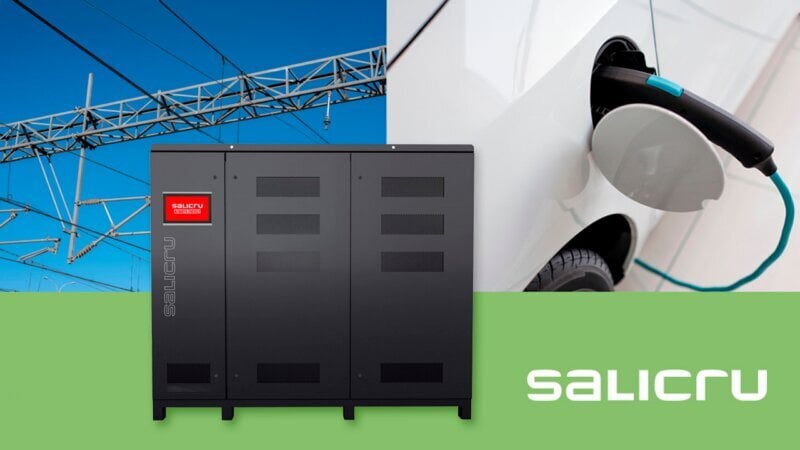
In an environment where efficiency and sustainability are critical, allowing that energy to go to waste is no longer viable. Salicru is highlighting this challenge to mark its participation in UK Rail 2026 with a solution designed to harness energy from the overhead line: the CS-MV.
Every time a train brakes, it generates energy which, in many current systems, is wasted. At the same time, stations, remote substations and new infrastructure, such as electric vehicle charging points, are demanding ever-increasing amounts of power. This disconnect between generation and consumption is one of the major hidden challenges facing the modern railway.
Salicru‘s CS-MV directly addresses this need. It is a bidirectional DC/AC converter capable of transforming energy in both directions, allowing energy to be recovered from the overhead line, adapted and redistributed to useful applications within the infrastructure itself. What was once a waste becomes a strategic resource, capable of providing an efficient power supply to railway substations, integrating so-called ‘ferrolineras’ for recharging electric vehicles, or connecting to energy storage systems.
Against a backdrop of energy constraints and decarbonisation targets, smart energy management is what sets conventional infrastructure apart from systems that are truly future-proof.
The CS-MV is also designed for both commuter and high-speed lines, meaning it meets both 3000V DC and 25,000V AC standards and can be adapted to suit the specific project. Salicru’s R&D team accounts for 6% of turnover, a figure more than three times the European average.
Salicru will present this vision at UK Rail 2026 alongside other companies within MAFEX, the Spanish railway industry association, as part of a wider shift. This philosophy aims to enable the railway infrastructure to become an energy-efficient, connected and sustainable ecosystem in its own right, meaning that the first step is no longer to generate more energy, but to make the most of the energy that already exists.
www.salicru.com
