
railway-international.com
22
'26
Written on Modified on
Edge Computers Target Transport and Industrial AI
SINTRONES launches mass-produced edge computing systems for railway, vehicle and industrial automation deployments.
www.sintrones.com
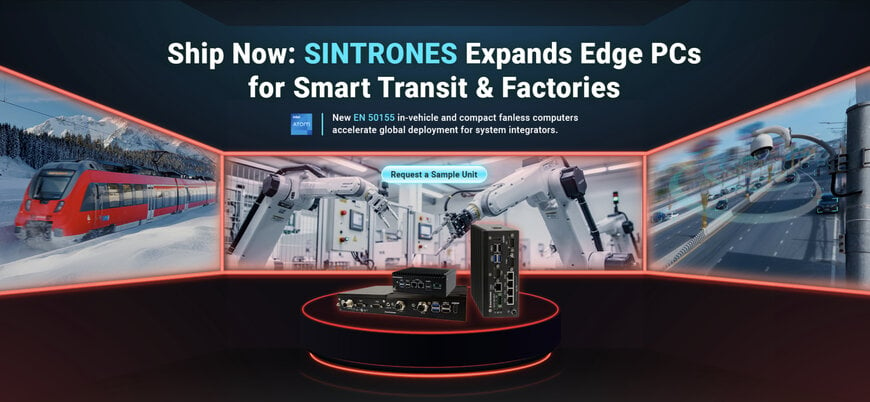
SINTRONES has started mass production of three new edge computing platforms designed for intelligent transportation, industrial automation, railway systems and surveillance applications. The VBOX-3132, SBOX-2625 and RBOX-1001-M12X are available for immediate shipment, targeting system integrators seeking shorter deployment timelines for edge AI and embedded computing infrastructure.
The systems use Intel Twin Lake N150 and Intel Atom Amston Lake x7000 processors, balancing power efficiency, ruggedness and computing performance for applications requiring continuous operation under demanding environmental conditions.
Edge computing platforms address transport and industrial deployment requirements
Increasing use of real-time analytics in industrial automation and transportation networks has intensified demand for edge computers capable of local data processing with low latency. The new SINTRONES portfolio targets environments including automotive fleets, railway operations, smart factories, retail systems and public surveillance.
The VBOX-3132 is designed for in-vehicle applications and complies with EN 50155 and E-Mark requirements. It supports a wide DC input range from 9V to 60V with ignition control intended to maintain operational stability during power transitions. Integrated CAN FD and Power over Ethernet (PoE) support enable connection with vehicle systems, sensors and IP cameras.
The device also supports wall and DIN-rail mounting, while consolidating I/O interfaces on one side to simplify installation in confined spaces.
Compact industrial systems prioritise low power consumption
The SBOX-2625 is a compact industrial edge computer weighing approximately 1.2 kg. It incorporates support for DDR5 4800 memory and uses a processor with a 6W thermal design power (TDP), targeting deployments where energy efficiency and operating cost are significant considerations.
Connectivity options include dual Intel 2.5GbE ports, six USB interfaces and three COM ports. The system integrates TPM 2.0 hardware security features for protection of operational data and supports M.2 expansion modules for Wi-Fi, LTE and 5G connectivity.
Railway computing system designed for harsh operating conditions
The RBOX-1001-M12X is engineered for railway applications including onboard and wayside surveillance. The platform complies with EN 50155 standards and supports operating temperatures from -40°C to 75°C.
Galvanic isolation power input covering DC 24V to 110V is intended to improve resilience in railway electrical environments. M12 connectors provide secure connectivity under vibration conditions, while dual SSD support enables local storage redundancy for video recording and data retention. The system also supports 1U rackmount expansion for deployment flexibility.
All three platforms are designed for continuous operation in embedded computing environments where environmental resistance, connectivity and long-term reliability influence deployment decisions.
Additional Context
Technical specifications and competitive benchmarking not included in the original product announcement
Industrial edge computers for transportation and automation commonly compete with platforms from Advantech, AAEON and OnLogic, with benchmark criteria including operating temperature range, EN 50155 compliance, power consumption, connectivity options and expansion capability. Railway-certified systems typically prioritise resistance to vibration, wide voltage tolerance and long lifecycle support.
Compared with conventional compact industrial PCs that often operate within narrower temperature ranges, the RBOX-1001-M12X supports -40°C to 75°C operation while incorporating EN 50155 certification and galvanic isolation power input, features generally associated with railway and rolling stock applications. The SBOX-2625’s 6W TDP configuration also positions it toward lower-power industrial edge computing deployments where energy efficiency and thermal management are key selection factors.
Edited by Natania Lyngdoh, Induportals editor, assisted by AI.
www.sintrones.com
