
railway-international.com
18
'26
Written on Modified on
Stratasys Advances Rail-Ready Additive Manufacturing
FDM PA6/66-GF30-FR is a new flame-retardant composite material designed to enable rail and transportation manufacturers to produce certified end-use parts and critical spare parts.
www.stratasys.com
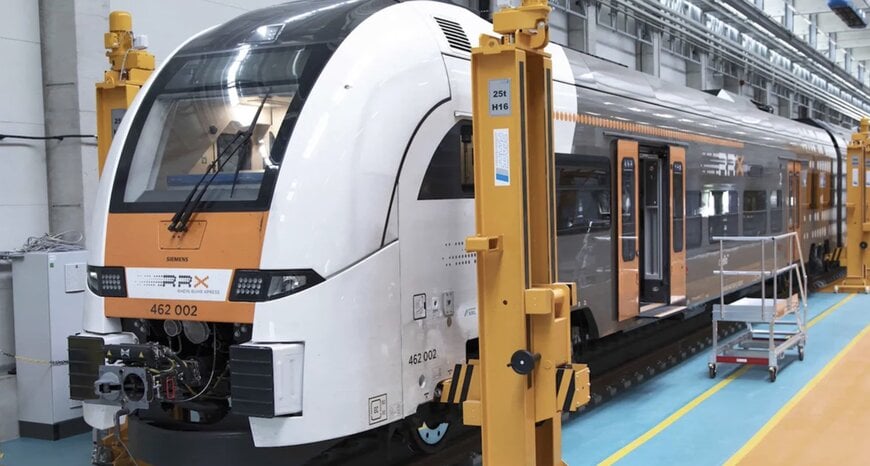
Stratasys has introduced FDM® PA6/66-GF30-FR, an industrial-grade, flame-retardant composite material developed for production components and critical spare parts within the rail and transportation sectors. The material is engineered specifically for deployment on Fortus® 450mc and F900® additive manufacturing systems.
Fire Safety Compliance and Mechanical Performance
The composite material is formulated to address industry compliance, operational performance, and asset management parameters within the transport sector. It achieves formal qualification under EN 45545-2 HL2 (R22/R23) and FMVSS 302 fire safety standards, making it suitable for load-bearing, functional applications inside railway rolling stock.
The material composition relies on a flame-retardant polyamide (PA) 6/66 copolymer matrix reinforced with 30% glass fiber by weight. This formulation provides enhanced structural stiffness and tensile strength compared to traditional polycarbonate flame-retardant (PC-FR) alternatives, offering competitive properties adjacent to high-performance materials such as ULTEM™ 9085 resin.
Processing Characteristics and Logistics Impact
Built for continuous production environments, the composite maintains consistent printability, high dimensional stability, and repeatable part quality. For architectural flexibility and complex internal geometries, the polymer is fully compatible with SUP4050B breakaway support structures, which optimizes post-processing efficiency and production line throughput.
Rail operators and original equipment manufacturers (OEMs) increasingly deploy additive manufacturing systems to facilitate on-demand spare part replacement. This localized production methodology shortens component lead times and lowers spare parts inventory holding costs, especially across long-life transit assets and recurring fleet maintenance schedules.
Lorenzo Gasparoni, 3D Printing Program Manager for the Alstom Group, noted that the material simplifies the implementation of additive manufacturing protocols within a certifiable framework required by the railway industry. Gasparoni stated that the glass-filled thermoplastic enables repeatable production of qualified components, while the interface with SUP4050B support layers ensures straightforward support structure removal to deliver high surface finish quality.
Additional Context
This section details technical specifications not included in the original news release.
Polyamide 6/66 copolymers combine the linear molecular structures of nylon 6 and nylon 66 to alter crystallization kinetics, reducing the melting point and internal processing stress compared to pure PA66 while retaining high chemical resistance against industrial hydrocarbons, oils, and automotive fluids. The incorporation of 30% chopped glass fibers alters the isotropic thermal shrinkage characteristic of unfilled polyamides during layer-by-layer material extrusion. This reinforcement significantly increases the material's flexural modulus and tensile strength while elevating the heat deflection temperature (HDT) under load. Extrusion printing of highly filled composite filaments typically requires wear-resistant extrusion nozzles, such as those fabricated from hardened tool steel or ruby-tipped assemblies, to prevent rapid abrasive erosion of the nozzle geometry.
The European railway fire safety standard EN 45545-2 categorizes interior and exterior rolling stock components based on their exposure risk, assigning set requirements designated from R1 to R28. Requirements R22 and R23 specifically regulate the flammability, smoke opacity, and gas toxicity indices for small interior components, such as passenger service units, structural brackets, and electrical housings. Hazard Level 2 (HL2) classification indicates that the consolidated material has passed specific testing thresholds, including critical heat flux metrics, minimum oxygen index limits, and strict smoke density constraints determined via standardized radiant heat chamber evaluations to verify that the parts delay flame propagation and limit toxic smoke production during a fire event.
Edited by Romila DSilva, Induportals Editor, with AI assistance.
www.stratasys.com
