
railway-international.com
24
'26
Written on Modified on
Nuvo-9200VTC: Powerful AI In-Vehicle Computer from Acceed
Fanless box PC combines desktop processors, PoE ports, and a vibration-resistant design for harsh mobile environments.
acceed.com
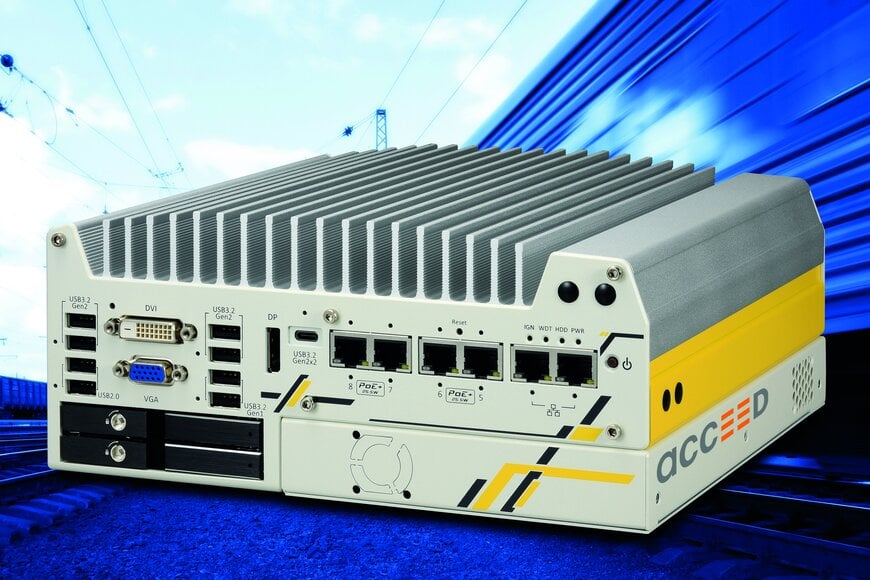
In-vehicle computers have historically forced compromises between raw processing power and environmental durability. Distributor Acceed is breaking this mold with the introduction of the Nuvo-9200VTC. Utilizing the LGA1700 socket with the Intel Q670E chipset, the system supports 12th to 14th generation Intel Core desktop processors (from i3 up to i9) with up to 24 cores. Paired with DDR5 memory and PCIe Gen4 NVMe storage, this fanless PC achieves up to 1.8 times higher performance than predecessor platforms. Engineered to operate in ambient temperatures ranging from -40 °C to +70 °C and carrying E-Mark and railway certifications, it is ideally suited for compute-intensive workloads such as AI inference, machine vision, and real-time data aggregation directly inside vehicles.
Comprehensive Connectivity and Modular Expandability
Another core feature is the system's extensive connectivity options. The controller offers four or eight PoE+ ports (25.5 W each) with a choice of rugged M12 screw connectors or standard RJ45 jacks, enabling the direct connection of a complete camera architecture without an external switch. Additional interfaces include nine screw-lock USB ports, one 2.5 GbE and one 1 GbE port, as well as galvanically isolated CAN bus and DIO lines. Furthermore, a patented PCIe expansion cassette allows for the integration of add-on cards, with waste heat efficiently dissipated outward or actively cooled via an optional fan cassette.
Additional Context: Technological Background and Market Dynamics
This section provides technological and market-specific background information not explicitly mentioned in the original press release.
Integrating desktop-grade CPUs into fanless, vehicle-certified housings represents a significant engineering challenge, as desktop processors generate substantially more thermal dissipation (with TDP classes up to 65 W) than typical embedded SoCs like Intel Atom. An efficient passive cooling architecture is vital here to prevent thermal throttling during peak summer temperatures inside a vehicle cabin. Furthermore, robust circular connectors like the M12 standard are crucial for reliability in rail and commercial vehicles, as continuous high-frequency shocks and vibrations can loosen conventional RJ45 plugs over time. The ability to run complex AI and machine vision applications locally at the edge reduces reliance on cellular connections, minimizes latency for safety-critical driver assistance systems, and saves considerable cloud bandwidth costs for data transmission.
Edited by Lekshman Ramdas, Induportals editor – adapted by AI.
www.acceed.com
