
railway-international.com
27
'26
Written on Modified on
Rugged Edge AI Computer for Fleet and Railway Mobility
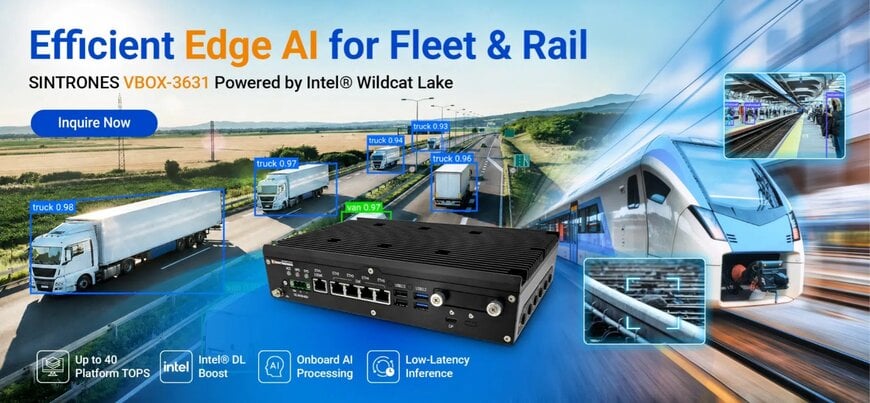
SINTRONES introduces the fanless VBOX-3631 edge AI platform powered by Intel Core Series 3 (Wildcat Lake) processors to enable low-latency onboard inference across transportation fleets and rolling stock.
www.sintrones.com
Deploying artificial intelligence across commercial vehicle fleets, autonomous mobile robots, and railway rolling stock presents significant architectural challenges due to intermittent cellular coverage and strict environmental tolerances. Relying continuously on centralized cloud infrastructure for video analytics and sensor processing introduces variable network latency, high cellular data transmission overhead, and potential data-governance vulnerabilities. Meanwhile, vehicle-mounted computers must execute real-time machine learning inference within tight power envelopes while enduring extreme ambient temperatures, high mechanical shock, and unstable electrical transients. Resolving these deployment constraints requires hardened, fanless edge computing hardware that integrates heterogeneous AI acceleration with vehicular network interfaces and intelligent power management.
Heterogeneous AI Acceleration with Intel Wildcat Lake
To bring real-time inference directly onboard vehicles without cloud dependency, SINTRONES developed the VBOX-3631, a fanless in-vehicle embedded computer built around Intel Core Series 3 (Wildcat Lake) processors. System integrators can configure the platform with Intel Core 7 350, Core 5 320, or Core 3 304 processors to balance computational throughput against power efficiency. On the flagship Intel Core 7 350 variant, the heterogeneous silicon architecture delivers up to 40 Platform TOPS of peak combined AI performance across three integrated compute engines: a CPU featuring two Performance cores and four Low-Power Efficient cores with Intel DL Boost for vehicle communications and data preprocessing, an integrated GPU providing up to 21 peak INT8 TOPS for parallel video processing, and a dedicated NPU delivering up to 17 peak INT8 TOPS for power-efficient onboard inference.
Using the Intel OpenVINO Toolkit, integrators can optimize and distribute neural network workloads across the CPU, GPU, and NPU to run intelligent video analytics, object detection, and sensor fusion locally. Rather than streaming continuous raw camera feeds to central servers, onboard applications can filter telemetry and transmit only selected event summaries. For vehicle and sensor integration, the chassis incorporates one 2.5GbE port, up to four GbE ports, and two CAN FD interfaces.
Vehicular Hardening and Intelligent Power Management
Engineered for harsh automotive and rail environments, the VBOX-3631 combines a passive fanless thermal architecture with mechanical shock and vibration resistance validated against specified MIL-STD-810H methods. Published specifications list E-Mark certification and EN 45545-2 (R25) fire safety compliance, alongside design alignment with EN 50155 railway rolling stock requirements. Optional locking M12 X-coded Ethernet connectors prevent physical disconnects under continuous vehicle vibration, while customizable power and I/O configurations accommodate diverse chassis layouts.
The fanless enclosure supports a wide operating temperature range of -40 °C to +70 °C under a published 0.6 m/s airflow condition. A 9 to 60 V DC wide-range power input paired with ignition detection and smart power management accommodates standard 12 V, 24 V, and 48 V vehicle electrical architectures. To protect against sudden power loss, an optional patented backup battery unit provides up to five minutes of emergency power for controlled system shutdowns, narrowing the operating temperature envelope to -10 °C to +50 °C when installed. For simplified field servicing, a front-accessible, removable RTC battery tray allows technicians to replace the coin-cell battery without disassembling the chassis.
Target Deployments Across Smart Mobility
The VBOX-3631 addresses edge computing workloads across four primary transportation domains:
- Fleet and Public Transportation: Executes driver monitoring, event detection, vehicle telemetry, predictive maintenance analytics, and fleet logistics, while noting that safety-critical ADAS functions require separate system-level validation.
- Railway and Rolling Stock Computing: Supports passenger information systems, onboard video analytics, equipment condition monitoring, and selected vision-based assistance workloads.
- Autonomous Logistics (AMR/AGV): Provides local compute and connectivity for multi-sensor fusion, robot telemetry, and compatible perception or navigation tasks.
- Smart City and Traffic Analytics: Operates as a localized processing node for automated license plate recognition, traffic observation, and object detection.
Additional Context
This section details technical specifications and competitive benchmarking not included in the original product announcement.
In automotive and railway embedded computing governed by EN 50155 (rolling stock electronic equipment) and EN 45545-2 (railway fire protection for materials and components), onboard systems must withstand severe voltage sags, surges, and transient spikes during engine cranking or pantograph arcing, alongside electromagnetic interference from high-voltage traction inverters. Furthermore, supporting Controller Area Network Flexible Data-Rate (CAN FD, standardized under ISO 11898-1) expands payload capacity from 8 bytes to 64 bytes per frame and boosts data-phase bitrates beyond 1 Mbps, allowing modern vehicle gateways to ingest high-frequency powertrain, braking, and diagnostic telemetry without bus congestion.
Within the ruggedized in-vehicle and railway edge AI computer market, the SINTRONES VBOX-3631 benchmarks directly against fanless transportation box PCs from Neousys Technology, Vecow, Lanner Electronics, and Advantech. While competing platforms often pair older Intel Core generations with discrete M.2 AI accelerator modules (such as Hailo-8) or rely on ARM-based NVIDIA Jetson Orin railway boxes, SINTRONES leverages Intel Core Series 3 (Wildcat Lake) to deliver 40 TOPS of native, integrated CPU/GPU/NPU acceleration alongside a wide 9 to 60 V DC input and patented internal backup battery protection, eliminating external accelerator cards and simplifying rail and fleet certification.
Edited by Romila DSilva, Induportals Editor, with AI assistance.
