
Santiago Metro and Alstom present the first train for Chile's future Line 7
In total, there will be 37 state-of-the-art trains, benefiting 1.6 million people.
www.alstom.com
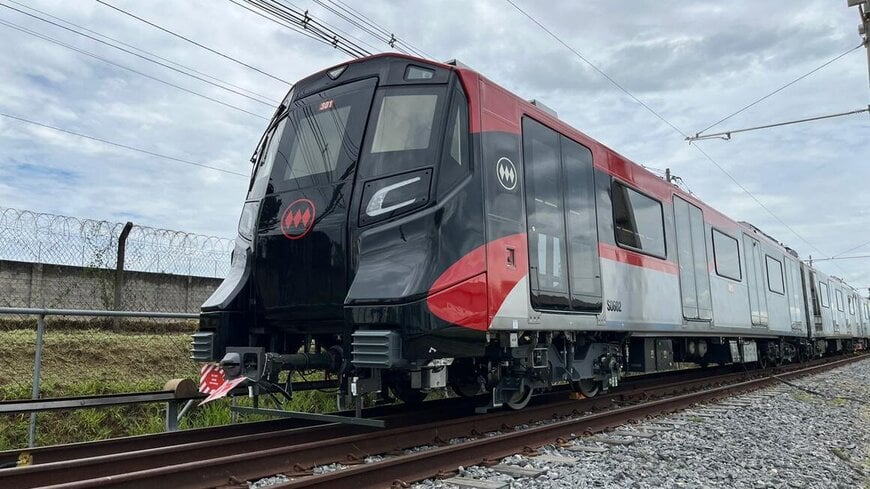
Alstom, a world leader in intelligent and sustainable mobility, and the Santiago Metro presented the first Metropolis AS-22-UTO train that will operate on the future Line 7. The event took place at the Alstom plant in Taubaté, São Paulo state, and was attended by representatives of the Santiago Metro, Guillermo Muñoz, Chairman of the Board, and Ximena Schultz, Projects Division Manager, the General Director of Alstom Brazil, Suely Sola, as well as other directors of the company's Latin American committee and technical teams.
The train is now beginning an important testing phase at the Taubaté plant, before its scheduled delivery in the second half of 2026, marking the start of deliveries of the 37 trains.
This milestone is especially significant in the context of the Santiago Metro's 50th anniversary celebrations and reinforces five decades of collaboration with the French company.
Guillermo Muñoz, president of the Santiago Metro board, stated: “This is a very important milestone for the company and for all Chileans who follow the progress of the Metro's project portfolio during the period of greatest expansion in its history. The Line 7 trains are 102 meters long, have a capacity for 1,247 passengers, and include two spaces for people with reduced mobility in each train. They are manufactured in stainless steel, which ensures greater durability and reduces electricity consumption. The cars will have four doors and wide, interconnected aisles between the carriages, ensuring an efficient flow of passengers. They will be equipped with air conditioning and an advanced passenger information system, with route and station updates, USB-C ports for charging, and a modern security system with high-resolution cameras and intercoms, allowing users to communicate with the Metro's control center.”
In total, Alstom will build 37 Metropolis trains, each with five cars, at its Taubaté facilities, as part of the contract between the company and the Santiago Metro. Under the same contract, Alstom will also supply the Urbalis CBTC signaling system, which will allow for driverless operation, increasing the efficiency and safety of the service. In addition to this agreement, Alstom signed two other contracts: one for the supply and construction of the tracks and overhead power system, and another for the supply of the electrical system. All three contracts include 20 years of maintenance, with a complete and innovative predictive maintenance system for the trains, tracks, and overhead power system.
“For over 70 years, Alstom Brazil has been manufacturing trains that keep South America moving, and today we welcome the latest addition to this proud tradition, with the first train for the future Line 7 of the Santiago Metro,” stated Suely Sola, General Manager of Alstom Brazil. “It was an honor to welcome our customers from Chile to present this first train and the teams working diligently on the entire fleet of 37 trains.”
For Waleria Haga, Alstom's Project Director for Line 7, “the presentation of the first train represents a very important step in a project that will improve mobility in Chile, offering reliable, safe, and accessible transportation. Line 7 will contribute to improving the commute of approximately 1.6 million people, making it faster, more efficient, and more sustainable. This project builds on Alstom's solid experience in manufacturing railway rolling stock in Latin America and its long-standing partnership with the Santiago Metro.”
Santiago Metro and Line 7
Currently under construction, Santiago Metro Line 7 will be 26 kilometers long and will have 19 stations. The line will cross seven municipalities: Renca, Cerro Navia, Quinta Normal, Santiago, Providencia, Vitacura, and Las Condes. Three of these municipalities (Renca, Cerro Navia, and Vitacura) will be integrated into the network for the first time, benefiting an estimated population of 1.6 million inhabitants.
When Line 7 becomes operational, it is estimated that the travel time between terminal stations will be 37 minutes, representing a 49% reduction compared to the current bus system (approximately 72 minutes).
The project will generate 24,000 jobs from the start of construction until its operation, scheduled for 2028. In the first year of operation of Line 7, an average daily demand of 194,000 passengers on weekdays and a total annual demand of 60 million passengers is projected.
Also in the first year of operation, it is expected to reduce approximately 33,000 tons of CO₂ in emissions and fuel consumption, which would be equivalent, in an estimated way, to planting 55,000 adult trees. The total investment in Line 7 is US$ 2.528 billion.
Santiago Metro Projection
Currently, the Metro network has seven lines, 143 stations, and 149 kilometers of track. It transports 2.4 million passengers per day and, in 2025, will have completed 661 million trips.
With the expansion projects—extension of Line 6 to the east and west and the new lines 7, 8, 9, and A (towards the airport)—by 2033 the metro will have 56 new stations and an additional 82.5 kilometers. The network will then have 199 stations, an increase of 39%, and 231.5 kilometers of track, a growth of 55%, making the Santiago Metro the longest system in Latin America.
Alstom in Chile
Alstom has been present in Chile for over 75 years, contributing to the country's infrastructure development, social progress, and environmental sustainability. As the main supplier of metro systems in Santiago and Valparaíso, it offers a wide range of innovative products and services. Economic growth has driven demand for urban, interurban, and freight rail infrastructure, and Alstom operates with expertise in these three areas, committed to improving quality of life and safety.
With more than 600 employees in eight units, Alstom operates in Chile with metropolitan and regional trains, signaling systems, and infrastructure and maintenance services. The company participates in important railway projects throughout the country, including the Santiago Metro, EFE Valparaíso, and Empresa de Ferrocarriles del Estado (EFE), such as the Alameda-Nos line.
To date, Alstom has supplied the Santiago Metro with the NS74, NS93, AS02, NS04, and NS16 train fleets. Soon, the new AS22 trains for Line 7 will join them.
Currently, more than 35,000 Metropolis trains are in operation or on order for over 70 cities in 40 countries, serving 80 customers and safely transporting approximately 15 billion passengers annually worldwide.
ALSTOM™ and Metropolis™ are protected trademarks of the Alstom Group.
www.alsto.com
