
railway-international.com
23
'26
Written on Modified on
Railway Pressure Sensors Improve Reliability in High-Speed Trains
Trafag supports rail OEMs with vibration-resistant pressure sensors designed for brake and pantograph systems, improving long-term stability and reducing maintenance requirements.
www.trafag.com
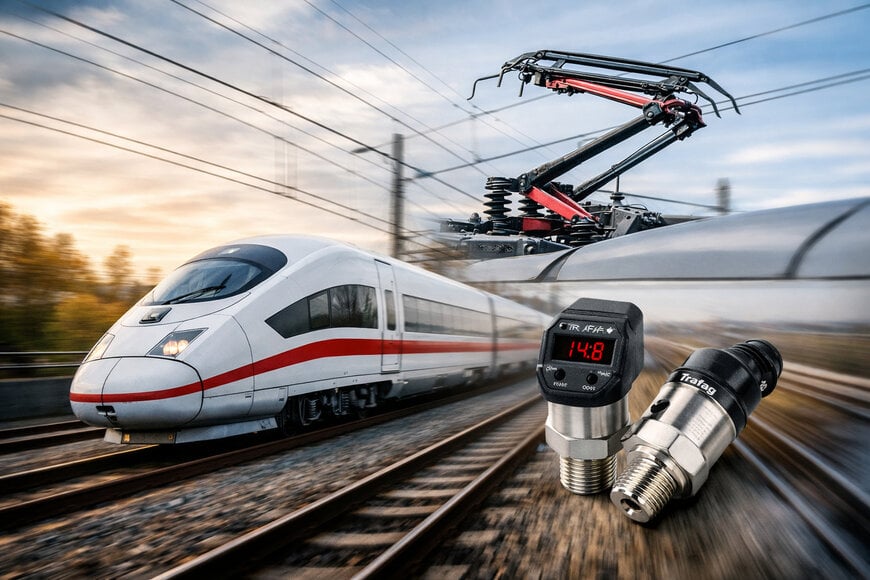
Railway rolling stock manufacturers are operating in an environment defined by higher speeds, increased automation, compact vehicle designs, and stricter safety requirements. Pressure monitoring plays a central role in critical subsystems, including braking, pneumatic suspension, door actuation, pantographs, and propulsion monitoring.
As train speeds increase and space constraints tighten, original equipment manufacturers (OEMs) face several technical challenges:
- Maintaining measurement accuracy under high vibration and shock
- Ensuring compliance with international railway standards such as EN 61373:2010 and EN 50155
- Reducing total cost of ownership amid rising capital and operating costs
- Extending maintenance intervals without compromising safety
To address these requirements, OEMs are deploying specialized railway pressure sensors engineered for long-term stability and resistance to extreme mechanical stress.
Engineering for Vibration Resistance
Railway environments expose sensors to continuous vibration, temperature variation, humidity, and electromagnetic interference. Components mounted on bogies, axles, or brake systems must meet the stringent Category 3 requirements of EN 61373:2010.
To enable installation in these high-stress locations, Trafag developed transmitters and switches designed to mechanically decouple sensitive electronics from pressure ports and connectors. This design strategy reduces stress on solder joints, circuit boards, and sensing elements.
The company also optimized internal circuit board stacking and mass distribution to shift resonant frequencies away from those encountered during rail operation. These mechanical adaptations are closely linked to signal stability: minimizing micro-movements helps prevent long-term drift and measurement deviation.
One outcome of this approach is transmitter accuracy of up to ±0.15% full scale (FS) in certain models. Sustaining this accuracy over extended service intervals reduces recalibration frequency and supports predictable lifecycle planning.
Brake and Pantograph Applications
Brake systems represent one of the most demanding applications for pressure measurement. Modern hydraulic architectures require sensors capable of detecting rapid full-range pressure changes within tenths of a second while maintaining switching accuracy under severe vibration. This is particularly critical in high-speed rail operations reaching speeds above 200 mph, as well as in alpine cog-rail applications where mechanical stresses are intensified.
Pantograph systems introduce additional challenges due to continuous motion, exposure to weather, and electrical noise. Sensors used in these systems must be compact, contamination-resistant, and mechanically robust.
OEMs increasingly request application-specific adaptations, including ruggedized connectors compliant with railway fire standards, specialized venting solutions for condensation control, and electronic interfaces compatible with onboard control architectures.
Supporting Predictive Maintenance Strategies
Although analog interfaces remain widely used, digital communication protocols such as CANopen are being integrated into high-speed trains and railway maintenance equipment. These interfaces enable transmission of measurement data alongside diagnostic information such as internal temperature.
This data supports predictive maintenance models, allowing operators to replace time-based servicing with condition-based monitoring. Early detection of drift or component degradation reduces unplanned downtime and helps optimize spare parts management.
Compliance with EN 50155 ensures that digitally connected sensors withstand the same environmental stresses as conventional analog systems.
Long-Term Stability and Reduced Lifecycle Costs
From an operator’s perspective, long-term signal stability is a decisive factor. Measurement drift can lead to recalibration cycles, component replacement, and operational disruption.
To mitigate these risks, Trafag employs a thin-film-on-steel sensing design in which the sensing element is integrated directly onto a metal substrate. This configuration reduces mechanical stress and thermal mismatch, improving resistance to fatigue and environmental degradation.
Low long-term drift enables extended maintenance intervals, fewer sensor replacements, and lower lifecycle costs. In safety-critical subsystems such as braking, this stability directly supports regulatory compliance and operational reliability.
Conclusion
As rail systems evolve toward higher speeds, tighter safety margins, and increased digital integration, sensor performance becomes a determining factor in overall system reliability. Rail OEMs are therefore prioritizing vibration resistance, long-term stability, and connectivity when selecting pressure measurement solutions.
The deployment of mechanically optimized and digitally capable railway pressure sensors reflects a broader industry shift: balancing compliance and durability with lifecycle cost efficiency in next-generation rail applications.
www.trafag.com
Engineering for Vibration Resistance
Railway environments expose sensors to continuous vibration, temperature variation, humidity, and electromagnetic interference. Components mounted on bogies, axles, or brake systems must meet the stringent Category 3 requirements of EN 61373:2010.
To enable installation in these high-stress locations, Trafag developed transmitters and switches designed to mechanically decouple sensitive electronics from pressure ports and connectors. This design strategy reduces stress on solder joints, circuit boards, and sensing elements.
The company also optimized internal circuit board stacking and mass distribution to shift resonant frequencies away from those encountered during rail operation. These mechanical adaptations are closely linked to signal stability: minimizing micro-movements helps prevent long-term drift and measurement deviation.
One outcome of this approach is transmitter accuracy of up to ±0.15% full scale (FS) in certain models. Sustaining this accuracy over extended service intervals reduces recalibration frequency and supports predictable lifecycle planning.
Brake and Pantograph Applications
Brake systems represent one of the most demanding applications for pressure measurement. Modern hydraulic architectures require sensors capable of detecting rapid full-range pressure changes within tenths of a second while maintaining switching accuracy under severe vibration. This is particularly critical in high-speed rail operations reaching speeds above 200 mph, as well as in alpine cog-rail applications where mechanical stresses are intensified.
Pantograph systems introduce additional challenges due to continuous motion, exposure to weather, and electrical noise. Sensors used in these systems must be compact, contamination-resistant, and mechanically robust.
OEMs increasingly request application-specific adaptations, including ruggedized connectors compliant with railway fire standards, specialized venting solutions for condensation control, and electronic interfaces compatible with onboard control architectures.
Supporting Predictive Maintenance Strategies
Although analog interfaces remain widely used, digital communication protocols such as CANopen are being integrated into high-speed trains and railway maintenance equipment. These interfaces enable transmission of measurement data alongside diagnostic information such as internal temperature.
This data supports predictive maintenance models, allowing operators to replace time-based servicing with condition-based monitoring. Early detection of drift or component degradation reduces unplanned downtime and helps optimize spare parts management.
Compliance with EN 50155 ensures that digitally connected sensors withstand the same environmental stresses as conventional analog systems.
Long-Term Stability and Reduced Lifecycle Costs
From an operator’s perspective, long-term signal stability is a decisive factor. Measurement drift can lead to recalibration cycles, component replacement, and operational disruption.
To mitigate these risks, Trafag employs a thin-film-on-steel sensing design in which the sensing element is integrated directly onto a metal substrate. This configuration reduces mechanical stress and thermal mismatch, improving resistance to fatigue and environmental degradation.
Low long-term drift enables extended maintenance intervals, fewer sensor replacements, and lower lifecycle costs. In safety-critical subsystems such as braking, this stability directly supports regulatory compliance and operational reliability.
Conclusion
As rail systems evolve toward higher speeds, tighter safety margins, and increased digital integration, sensor performance becomes a determining factor in overall system reliability. Rail OEMs are therefore prioritizing vibration resistance, long-term stability, and connectivity when selecting pressure measurement solutions.
The deployment of mechanically optimized and digitally capable railway pressure sensors reflects a broader industry shift: balancing compliance and durability with lifecycle cost efficiency in next-generation rail applications.
www.trafag.com
