
Presence and Timer Dimming: Are We Saving Energy at the Cost of Passenger Confidence?
As the rail sector pursues ever greater energy efficiency, adaptive lighting systems promise incremental savings.
ivisionuk.com
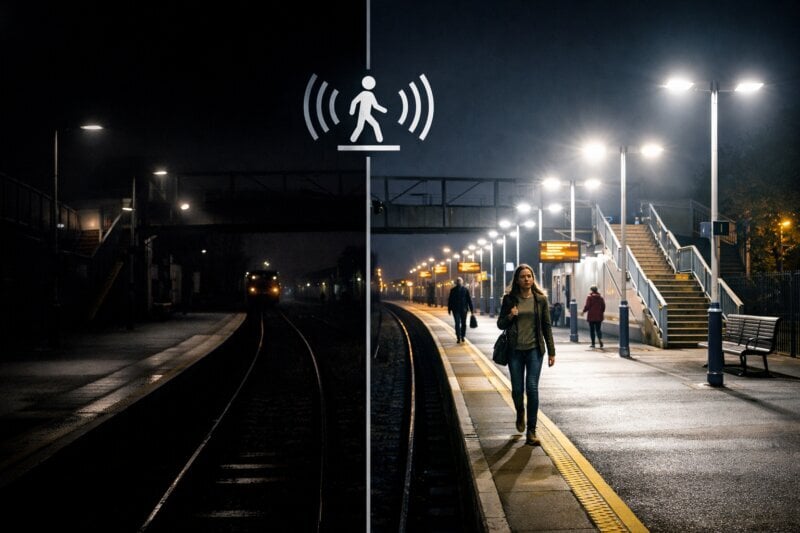
But in passenger environments, could these measures unintentionally undermine the confidence and reassurance that good lighting is meant to provide?
For passengers arriving at a station late at night, lighting is often the first indication that the railway is safe, operational, and ready to serve them. A well-lit platform, footbridge, or station approach provides reassurance and supports confident movement. Conversely, environments that appear dimly lit or only partially illuminated can create uncertainty, particularly where passenger numbers are low. As the rail industry continues its drive toward greater energy efficiency, it is important to ensure that measures intended to reduce consumption do not inadvertently undermine the confidence and reassurance that public lighting is designed to provide.
The transition to LED lighting across the rail network has been one of the most successful infrastructure efficiency programmes in recent decades. Energy consumption has reduced significantly, while lighting performance, reliability, and controllability have improved. Network Rail’s current lighting guidance recognises that station lighting must be designed to support the operational railway environment, while also addressing maintenance, inspection, and long-term asset management requirements [1].
With these substantial gains now realised, attention has increasingly turned to extracting further incremental savings through presence detection and timer-based dimming systems. These systems reduce lighting output when areas are unoccupied and restore full output when movement is detected. When applied appropriately, adaptive lighting can enhance both efficiency and passenger experience. However, their application in passenger environments requires careful consideration.
Lighting in railway stations serves a purpose beyond enabling visibility alone. It plays a central role in enabling passengers to move safely and confidently through the station environment. UK government guidance recognises that adequate lighting is essential to enable people to navigate transport infrastructure safely and independently, particularly during hours of darkness [2]. This highlights the importance of lighting not only as a technical system, but as a critical component of passenger accessibility and reassurance.
Presence-based dimming systems typically reduce lighting output to a small proportion of full output—often between 10% and 30%—when no movement is detected. While technically compliant, this can result in environments that appear visually dark or inactive. When lighting becomes reactive rather than continuously present, passengers are no longer entering a consistently lit environment, but one that responds only after their arrival.
A typical example might be a passenger arriving at a suburban station late in the evening. As they approach the station entrance or footbridge, the area may appear dimly lit or inactive until their presence triggers an increase in lighting level. While the system is functioning as designed, the initial impression can be one of an unoccupied environment. In contrast, a consistently illuminated space immediately communicates that the station is operational, maintained, and safe to use. This initial perception can play an important role in shaping passenger confidence, particularly at quieter stations or during off-peak periods.
This distinction is particularly relevant in areas such as station entrances, footbridges, subways, and car parks. Consistent ambient lighting helps communicate that a space is operational, maintained, and safe to use. Lighting that appears intermittently reduced may undermine this reassurance, even where technical lighting requirements are met.
Lighting also supports wider operational and safety systems across the railway. CCTV systems, while capable of operating in low-light conditions, achieve optimal performance where lighting levels are consistent and uniform. Stable ambient lighting supports clear, usable imagery across station environments, particularly in areas such as entrances, footbridges, and car parks. Consistent lighting conditions also support staff confidence, enabling safe inspection, monitoring, and operation of station environments during quieter periods. In this way, lighting functions not only as a passenger amenity, but as a critical component of the wider operational ecosystem.
Modern lighting control systems, including sensors and adaptive controls, offer powerful tools to improve efficiency and tailor lighting to operational needs. These technologies are increasingly used across the rail network to enhance performance and reduce energy consumption. However, their application must be carefully matched to the function of the space. In passenger environments where reassurance and visibility are critical, maintaining an appropriate baseline level of lighting remains essential. Adaptive controls should enhance lighting performance, not create conditions where environments appear unlit or inactive between periods of use.
It is also important to consider the scale of the potential savings. The transition from legacy lighting to LED delivered transformational reductions in energy consumption. By comparison, the additional savings available from presence-based dimming are incremental. While beneficial in appropriate contexts, these marginal gains must be balanced against their potential impact on passenger experience and the overall usability of railway environments.
Railway infrastructure exists to serve the people who use it. Lighting plays a fundamental role in enabling safe, confident, and independent movement. It signals that spaces are operational, accessible, and safe to use. If lighting strategies unintentionally make environments appear less safe or less reliable, this risks undermining the very purpose lighting is intended to serve.
Adaptive lighting remains a valuable tool when applied appropriately. However, its use in passenger environments should be guided not only by energy efficiency objectives, but also by a clear understanding of passenger experience and operational effectiveness.
As the rail sector continues to pursue ambitious sustainability targets, it is essential that lighting design maintains a balanced perspective—recognising that the success of public lighting is measured not only in energy savings, but in the confidence, safety, and reassurance it provides to passengers.
References
[1] Network Rail, Lighting Design in Stations (NR/GN/CIV/200/08), 2024
https://www.networkrail.co.uk/wp-content/uploads/2024/08/NR-GN-CIV-200-08-Lighting-Design-In-Stations.pdf
[2] Department for Transport, Inclusive Mobility: A Guide to Best Practice on Access to Pedestrian and Transport Infrastructure
https://www.gov.uk/government/publications/inclusive-mobility-making-transport-accessible-for-passengers-and-pedestrians
www.ivisionuk.com
