
Why Modular Construction is Still the Exception on Britain’s Railways — and Why That Needs to Change
Modular construction is no longer a niche idea in British infrastructure delivery. In sectors such as healthcare, hospitality and commercial property, it has become an increasingly normal way to build.
ivisionuk.com
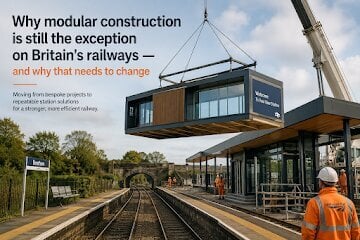
Hotel rooms are manufactured and fitted out off-site before installation. Healthcare providers routinely use modular construction to expand clinical capacity quickly and with minimal disruption to ongoing services. At the Royal Stoke University Hospital, a 12-bed modular critical care unit — including an isolation facility — was delivered in just 24 weeks while normal hospital operations continued. At the Clatterbridge Cancer Centre in Liverpool, 30 per cent of the structure was delivered using off-site methods, contributing to a 23 per cent overall programme saving and a reduction in on-site labour equivalent to nearly 6,000 working weeks.
Yet Britain’s railways continue to rely heavily on traditional construction methods, particularly at smaller stations. Despite years of discussion around modern methods of construction, many station upgrades still involve prolonged site activity, repeated possessions and complex works carried out directly within operational railway environments.
That contrast is becoming harder to justify.
The railway industry has already demonstrated that modular delivery can work. Programmes such as Access for All have successfully rolled out repeatable accessibility infrastructure across large parts of the network. Modular footbridges, precast platform systems and lift installations are now familiar features of station upgrades. Network Rail has also previously explored modular station concepts directly through schemes such as Greenhithe, Mitcham Eastfields and Uckfield, where significant elements were manufactured off-site before rapid installation.
The problem, therefore, is no longer whether modular stations are technically possible. Britain’s railway has already answered that question.
The more important question is why these approaches remain isolated examples rather than the basis of a broader delivery model for smaller stations across the network.
Part of the answer lies in how modularity is still being approached within rail infrastructure. In many cases, the industry has adopted modular construction at component level rather than system level. Individual assets may be prefabricated, but projects themselves often continue to follow conventional construction logic. A modular footbridge, for example, may still require follow-on installation of lighting, communications systems, cabling, CCTV and power infrastructure through multiple additional site visits after the structure itself has been installed.
This fragmentation is not simply a delivery inefficiency — it is a structural feature of how rail projects are currently procured. Network Rail’s own Station Design Principles documentation has acknowledged that previous modular station attempts were not cost-effective because they were “delivered as isolated items and not as part of an overall programme of works,” with the result that “the inherent benefits of modularity were never realised.” That observation goes to the heart of the problem: when procurement structures treat each station as a bespoke scheme rather than a repeatable deployment, modular components cannot compound into programme-level savings.
Other sectors increasingly avoid this fragmentation. Their aim is not simply to manufacture components off-site, but to deliver integrated systems that arrive largely complete, pre-tested and close to operational. That distinction matters because it fundamentally changes the nature of delivery. The project stops being a prolonged construction exercise and becomes a far shorter installation and commissioning exercise instead.
For smaller railway stations, the advantages could be substantial.
Many local stations share common characteristics. Their layouts are often relatively simple. Passenger requirements are broadly repeatable. Accessibility needs are well understood. Operational interfaces are generally less complex than those found at major terminals. In almost any other sector, these are precisely the conditions under which modular construction scales effectively.
Yet smaller stations are still frequently treated as bespoke engineering schemes. Design work is restarted repeatedly. The same delivery risks are reintroduced from project to project. Sites become construction environments for extended periods rather than locations for rapid installation.
This is not primarily an engineering limitation. It is a delivery choice.
That matters because traditional station construction creates disruption out of proportion to the scale of many upgrades. Even relatively modest schemes can involve prolonged on-site activity within constrained operational environments, affecting passengers, operators and local communities alike.
A more integrated modular approach changes the sequence entirely. Major station elements can be manufactured off-site while the existing railway continues operating normally. Installation can then take place during shorter possession windows, with much of the assembly already complete before modules even arrive on site.
In some cases, entirely new station sections could potentially be constructed adjacent to existing facilities before final connection into the operational railway. The practical benefits are obvious: less disruption, shorter installation periods, lower on-site safety exposure and greater programme predictability.
There is also a wider strategic benefit that rail has yet to fully exploit.
Other industries gain enormous advantages from manufacturing learning curves. Repeatable delivery allows installation teams to refine processes, suppliers to improve production efficiency and quality assurance systems to mature over time. Continuous improvement becomes embedded within the programme itself. The UK Construction Innovation Hub has estimated that integrated modular approaches can shift up to 80 per cent of site activity off-site — a transformation in risk profile that smaller station programmes are well-placed to capture, given the repeatability of their layouts and requirements.
Railway station delivery rarely benefits from this dynamic because projects are still too often treated as isolated schemes rather than repeatable deployments. The industry repeatedly resets learning instead of compounding it.
That has implications not just for efficiency, but for cost control, programme certainty and long-term delivery capability.
Importantly, none of this depends on speculative future technology. The engineering already exists. Off-site manufacturing, integrated building services, modular structural systems and precast rail infrastructure are all well established within the wider construction sector and increasingly familiar within rail itself. The UK supply chain has demonstrated the necessary capability across healthcare, commercial and justice sector programmes. What remains inconsistent is the commissioning model around it: procurement structures that favour isolated bespoke delivery over coordinated programme-based deployment prevent suppliers from investing in the repeatable systems that would deliver genuine cost and programme benefits.
Large city terminals will almost always require significant bespoke engineering because of their operational intensity, physical constraints and heritage considerations. Smaller stations are different. They are precisely where standardisation should work best.
The railway has already shown that modular stations and modular infrastructure can work safely and effectively. Network Rail’s own analysis has identified why previous attempts fell short. Other sectors have already embraced manufacturing-led delivery at scale, with measurable results. What remains uncertain is whether the commissioning and procurement frameworks governing smaller station upgrades will evolve to reflect that reality.
For Britain’s smaller stations, the opportunity is increasingly difficult to ignore. The challenge is no longer proving the concept. It is deciding to apply it consistently.
www.ivisionuk.com
