
Intelligent Infrastructure Monitoring: From Sensors in the Track to Decisions in the Control Room
Modern railways are increasingly turning to intelligent infrastructure monitoring to understand asset condition in real time, link sensor data with ground truth and integrate insights into maintenance planning, writes Dino Velic, R&D Project Manager Intelligent Turnout at voestalpine Signaling Austria GmbH.
www.voestalpine.com
© voestalpine Railway Systems
Modern railway networks are increasingly relying on intelligent infrastructure monitoring to ensure safety, availability and cost efficiency. These systems combine advanced sensor technologies with data-driven analytics to detect the health of critical assets. This enables predictive maintenance and reduces unplanned downtime by detecting anomalies that indicate wear, cracks or ballast deterioration before they escalate into costly failures.
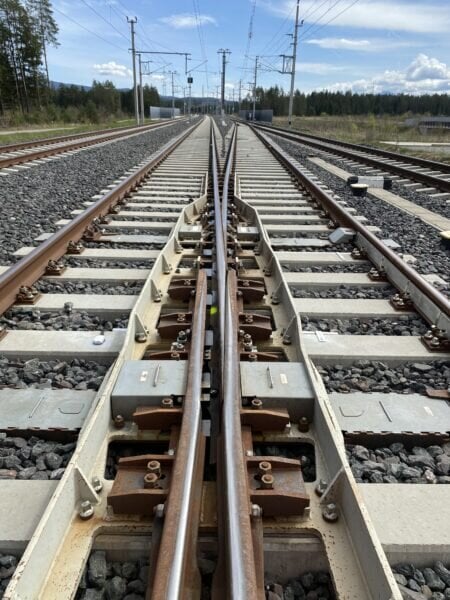
Infrastructure monitoring begins with the deployment of sensors across key turnout components such as switch rails, crossings, swing noses, detector rods and sleepers. These sensors capture vibrations, accelerations and/or acoustic emissions during train passages, based on the use case and monitoring purpose of the system. For switch operation monitoring a system may use current transducers, pressure, fluid level, temperature, humidity and/or inductive sensors, depending on the type of point machine.
Monitoring and Sensor Integration
voestalpine Railway Systems has recently been involved in several demonstrator projects of its zentrak portfolio across Europe, with the aim of increasing the availability of switches and reducing service life costs through advanced diagnostic technologies. These enable more precise monitoring and analysis through the installation of multi-sensor arrays and laser-based geometry scans to validate degradation models.
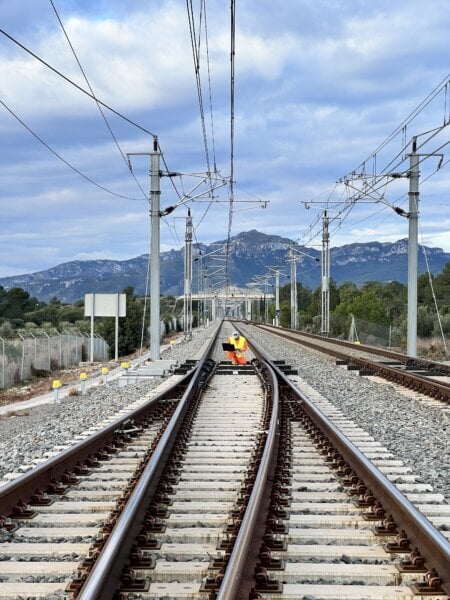
Figure 2: Mixed traffic turnout equipped with monitoring for ballast quality, crossing wear and switch rail monitoring.
© voestalpine Railway Systems
The installed sensor technology, together with the associated data analysis and integrated software solution, forms a comprehensive monitoring concept. Identifying anomalies with a sufficient lead time, the system then generates a corresponding message, which enables the necessary measures to be taken at an early stage. This in turn, improves the predictability of maintenance work, minimising downtime and its impact on operations.
Modular Architecture for Diverse Track Environments
While voestalpine Railway System’s intelligent monitoring system is based around a core architecture, its modular design enables it to be adapted to the exact requirements and specification of each infrastructure manager, including track and traffic type.
This is hugely important because the turnout design and geometry in railway environments vary and have a significant influence on the monitoring system design. Degradation behaviour is also highly affected by track materials used and therefore needs to be considered. Operational parameters such as train types and speed also impact not just sensor locations, but the algorithm used for analysis. All this was key in the development of voestalpine Railway System’s recent demonstrator solutions.
Data Processing and Quality Assurance
When it comes to intelligent monitoring systems, the raw data is only the starting point. A monitoring platform applies advanced algorithms to interpret sensor signals and predict asset behaviour, which means high quality data is essential for reliable monitoring.
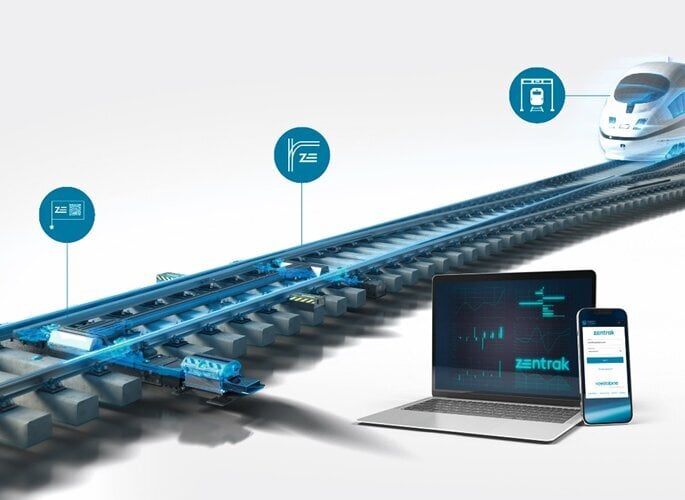
Figure 3: zentrak ecosystem with asset management & maintenance management, infrastructure monitoring and rolling stock monitoring module.
© voestalpine Railway Systems
Therefore, data must undergo rigorous sanity checks, filtering and validation to remove noise and outliers before analysis. Data engineering processes ensure consistency across diverse sources, such as wayside sensors, rolling stock telemetry and inspection reports. Depending on the use case and algorithm, this can involve basic cleaning and filtering, or more advanced techniques in time domain and frequency domain.
After this filtering and preprocessing, specific features are extracted from the signals, such as extrema or amplitudes per axle. Descriptive statistics, such as mean and standard deviation, are computed to capture the distributional properties and variability of the data. This step is crucial for reducing data volume and performing preprocessing to enable accurate health state assessment and effective visualisation.
Advanced Algorithms for Condition Assessment
The algorithm then used for analysis strongly depends on the available data, required accuracy and precision, and the system’s key purpose.
Data-driven models are ideal when large volumes of labelled data exist, for example. This enables machine learning (ML) techniques to be applied for anomaly detection and trend prediction. If a ML approach is chosen, it’s important to consider the data quality, presence or absence of labelled data or generally if a supervised or unsupervised approach is more suitable.
Physics-based models are applied where mechanical principles dominate, such as turnout geometry or stress analysis, and wherever output parameters must remain descriptive and reconstructable to ensure interpretability and compliance with engineering standards. Hybrid models become particularly valuable when labelled data is scarce or incomplete because they combine physical insights with data-driven adaptability, offering robustness where purely data-driven or purely physics-based approaches reach their limits due to constraints in data availability, computational efficiency, or accuracy requirements.
In many cases, combining different methods yields the best results. For example, operational parameters can be estimated using data-driven approaches, while the estimation of wear state and ballast quality relies on physics-based models. Hybrid strategies provide a mechanism to balance interpretability with predictive accuracy, ensuring robust performance in complex systems where neither a purely data-driven nor a purely physics-based approach can satisfy all functional and reliability requirements.
In voestalpine Railway System’s applications, most algorithmic approaches are grounded in physical modelling with only specific sub-tasks handled by data-driven methods. In other cases, the required logic is very straightforward, using basic physical principles such as calculating position from velocity and time, or applying simple threshold-based checks. Essentially, many challenges can be addressed effectively with simple, rule-based algorithms rather than complex models.
The Ground Truth Challenge
One of the most complex issues in infrastructure monitoring is establishing ground truth – the reference against which algorithm predictions are validated. Today, this information comes from disparate sources including visual inspections, fault clearance reports and measurement train data. These systems often operate independently, are sometimes managed by different companies, and follow different formats or conventions. As a result, the quality and granularity of the documentation can vary significantly, which makes using it as a reliable benchmark challenging.
Reports and inspection records are treated as ground truth data, however, their proper documentation is always demanding. When recorded manually on-site, limited time and poor weather conditions – such as rain – make accurate written documentation hard or even impossible. If reporting is postponed and completed later at the maintenance base, there is a risk of losing critical details, which can affect the reliability of the benchmark used to validate monitoring results. It’s therefore essential that the documentation quality consistently improves so that both parties – infrastructure managers and system providers – can benefit. Integrating these heterogeneous data streams into a unified platform requires robust data-fusion techniques, standardised protocols and, crucially, data that’s provided in machine-readable formats with the right level of detail.
Beyond harmonisation, questions of data accessibility and ownership also play a major role. Ground truth information needs to be available across platforms, suppliers and operators, while still respecting contractual and regulatory boundaries. Only when quality, standardisation, format, access and ownership are addressed together can ground truth fully support accurate model validation and continuous improvement of intelligent monitoring systems.
Storage: Cloud vs. On-Premise
Another thing to consider when using an intelligent infrastructure monitoring system is where to store the data it produces. This decision depends on several factors, including an infrastructure manager’s approach to risk, internal regulations and budgets. Because they’re responsible for safety-critical infrastructure, many infrastructure managers are guided – and sometimes restricted – by strict internal and national rules on data governance. On-premise solutions are usually the most straightforward way to comply with these requirements, as they offer greater control over data, security and system configuration. However, they demand higher upfront investment, strong in-house IT expertise and ongoing responsibility for maintenance, security and updates.
At the same time, there’s a clear trend towards cloud solutions, whether fully cloud-based or in hybrid setups that respect specific regulations and standards (for example, using cloud servers in approved locations). Cloud platforms offer scalability, high computational performance and easier remote access, as well as simpler integration with third-party analytics tools. They’re particularly attractive for smaller railway infrastructure operators without extensive IT departments, because much of the maintenance and security burdens shift from the operator to the cloud provider. The trade-off is that cloud deployments depend on network connectivity and may raise additional cybersecurity and compliance questions that must be carefully managed.
Closing the Loop: Integration, Feedback and Future Developments
For intelligent monitoring to deliver real value, insights must flow back to maintenance teams in a clear, actionable form. This feedback loop is not just helpful – it’s a necessity. When monitoring results are systematically integrated into maintenance and asset management processes, operators can schedule interventions earlier, deploy resources more efficiently and significantly reduce track possession times. These algorithms continuously refine their predictions through feedback loops from maintenance activities, improving diagnostic accuracy over time.
Recent demonstrator projects between voestalpine Railway Systems and infrastructure managers have focused on exactly this challenge. In these pilots, an infrastructure monitoring platform is being implemented together with asset management and maintenance software. This combination creates a unified information layer and provides a comprehensive view of infrastructure assets over their entire lifecycle.
As part of these projects, concepts are being developed for the seamless integration of monitoring solutions into existing IT landscapes and maintenance workflows. This includes defining how monitoring data is visualised, how alerts are prioritised and forwarded, and how condition information is linked to work orders and asset histories. Once the demonstrators are complete, the results will be evaluated to quantify the added value of comprehensive integration, with particular attention to minimising closure times, optimising maintenance intervals and increasing the availability of turnouts (or assets) across the network.
The findings are also intended to inform new concepts for monitoring different types of turnouts, reflecting their specific geometries, load conditions and degradation behaviours.
Looking ahead, the greatest impact is expected from holistic platforms that tightly couple infrastructure monitoring, asset management and maintenance planning within a single digital ecosystem. By combining advanced sensors, robust algorithms and integrated data platforms, operators can move decisively from reactive repairs to predictive maintenance strategies, ensuring safer, more reliable and cost-efficient railway networks for the future.
www.voestalpine.com
