
railway-international.com
08
'26
Written on Modified on
New Trains to Modernize the RER B
Île-de-France Mobilités is investing with Alstom and CAF in a new generation of trains to increase capacity, comfort, and operational reliability on the RER B line.
www.alstom.com
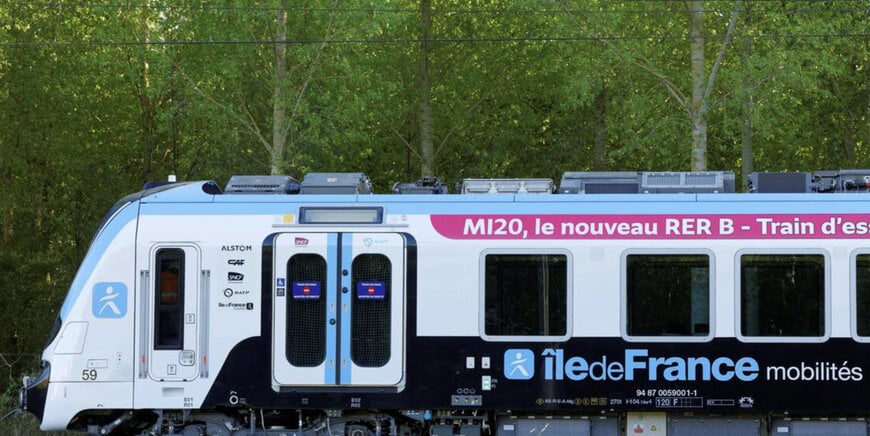
With nearly one million passengers per day, the RER B is one of the busiest railway lines in Europe. To address operational constraints and improve passenger conditions, Île-de-France Mobilités launched a rolling stock renewal program with the acquisition of 146 new MI20 trains, which will progressively replace the MI79 and MI84 trains currently in service.
The project, fully financed by Île-de-France Mobilités with an investment of €2.5 billion, is being carried out in partnership with operators RATP and SNCF Voyageurs. The trains are designed and manufactured by the Alstom/CAF consortium.
A Line Under High Operational Pressure
The RER B connects Paris-Charles-de-Gaulle Airport and Mitry-Claye in the north with Robinson and Saint-Rémy-lès-Chevreuse in the south, crossing central Paris. The line plays a strategic role in the regional transport network and faces increasing demands related to passenger volume, punctuality, flow management, and capacity.
Within this context, the rolling stock renewal program aimed to increase passenger capacity, reduce station dwell times, improve accessibility, and enhance onboard comfort for daily commuters.
Train Architecture Designed for Passenger Flow
The new MI20 trains were developed to optimize passenger circulation and adapt interior spaces to different travel needs. Each 104-meter-long train will be able to carry up to 1,063 passengers, representing up to 35% more capacity compared to the current fleet. Seating capacity reaches 342 seats, an increase of 22%.
The train architecture alternates single-deck and double-deck cars to combine passenger capacity with comfort. Step-free access areas have been integrated for passengers with luggage, strollers, or wheelchairs, while the double-deck sections are designed to provide additional seating and comfort for longer journeys.
Wide gangways and enlarged corridors, reaching nearly one meter in some cars, are intended to facilitate onboard movement and improve passenger distribution throughout the train. The 14 doors on each side of the train also help reduce station stop times and improve line operations.
Accessibility and Onboard Equipment
The MI20 trains were designed to meet the accessibility requirements of the Île-de-France transport network. Level boarding access and reduced platform gaps are intended to speed up boarding and alighting, including in curved stations.
The trains will be equipped with air conditioning, heated flooring, USB-C charging ports, passenger information displays, and a video surveillance system featuring 44 cameras with real-time image transmission. The rolling stock also incorporates 25% recycled materials.
Industrial Production and Dynamic Testing
On May 7, 2026, at the Alstom facility in Crespin, northern France, the Alstom/CAF consortium presented the first assembled trainset and carried out its first test run. This milestone marks the beginning of dynamic testing for the future RER B train.
At that stage, ten trainsets were already in industrial production. The project schedule was reorganized to address initial delays and secure the next stages of manufacturing and technical validation.
According to the project partners, the target remains the introduction of the first trains into commercial service on the Île-de-France network by the end of 2028.
Edited by Maria Brueva, Induportals editor – adapted by AI.
www.alstom.com
