
railway-international.com
14
'26
Written on Modified on
Webuild Starts Gardena Tunnel Excavation with TBM Kathrin
Brenner rail infrastructure project advances Alpine freight and passenger corridor capacity between Italy and Central Europe.
www.webuildgroup.com
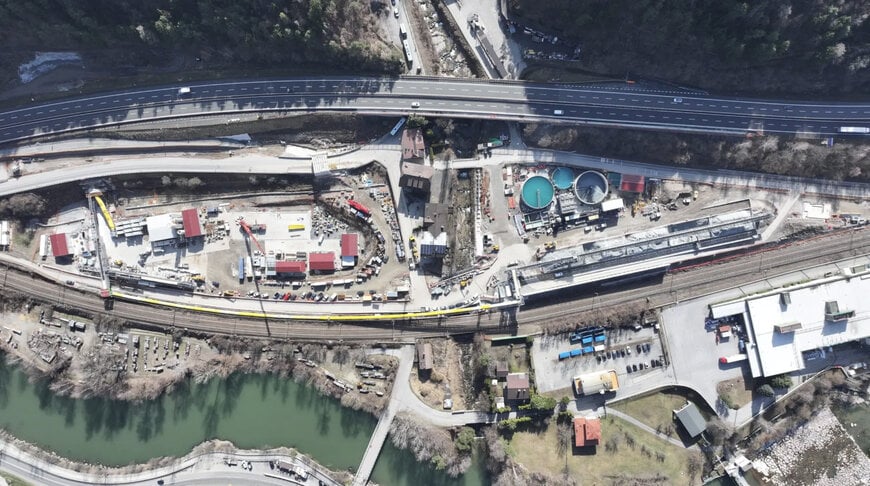
Webuild Group has begun excavation of the Gardena Tunnel on the Fortezza–Ponte Gardena section of the Brenner southern access rail project in northern Italy. The excavation phase started with tunnel-boring machine Kathrin following completion of the 650-metre Funes exploratory access tunnel, marking a major construction milestone for the broader Brenner Base Tunnel railway corridor.
The project forms part of the expansion of the Munich–Verona rail axis and is intended to increase freight and passenger rail capacity across the Alpine corridor linking Italy and Central Europe. The infrastructure upgrade is designed to support modal transition from road freight to rail transport while reducing travel times and improving long-distance rail efficiency.
Tunnel excavation begins beneath the Alps
The Gardena Tunnel is being constructed within the Fortezza–Ponte Gardena lot in the Trentino-Alto Adige region on behalf of Rete Ferroviaria Italiana, part of the FS Italiane Group.
The excavation uses the tunnel-boring machine Kathrin, a 144-metre-long dual-mode TBM equipped with a cutterhead nearly 10 metres in diameter. The machine will excavate the twin tunnel tubes forming the Gardena Tunnel as well as interconnection tunnels linked to the future Ponte Gardena station infrastructure.
According to Webuild, the project includes excavation of more than 16 kilometres of tunnels and installation of approximately 9,000 precast concrete lining segments.
The Fortezza–Ponte Gardena section is being developed by a consortium led by Webuild together with Implenia and SELI Overseas, Webuild’s tunnelling subsidiary.
Railway expansion for Alpine freight transport
The new rail section represents the first phase of the four-track expansion of the southern approach to the Brenner corridor between Munich and Verona. The route is designed primarily underground, with approximately 52 kilometres of tunnels planned across the wider project.
Reducing track gradients compared with the existing railway line is expected to improve freight train efficiency, increase transport capacity, and support higher operational speeds for both passenger and freight services.
The Brenner corridor is one of Europe’s most important north-south transport routes, connecting Mediterranean logistics infrastructure with Central and Northern European industrial regions. Rail capacity expansion along this axis is increasingly viewed as critical for reducing road freight congestion and lowering transport-related emissions across the Alpine region.
Dual-mode TBM technology for complex geology
Webuild stated that Kathrin was specifically designed to manage complex Alpine geological conditions. The dual-mode TBM can alternate between hard rock excavation and operation within unstable ground conditions, allowing greater flexibility during tunnelling operations beneath variable mountain geology.
The machine previously completed excavation beneath the Brenner motorway without interrupting surface traffic, demonstrating controlled tunnelling capability in sensitive infrastructure environments.
According to the company, the TBM incorporates high-efficiency motors and cooling water recovery systems designed to reduce energy consumption during excavation. Webuild stated that the system lowers energy usage per cubic metre excavated by approximately 20 to 25 percent compared with conventional tunnel-boring technologies.
Parallel construction activities across the corridor
Additional work continues simultaneously across several construction zones within the broader railway expansion project. Preparations are underway at the Forch cavern for excavation of the 15-kilometre Scaleres Tunnel, while progress continues on the Chiusa access tunnel, where approximately 1,400 metres of the planned 1,800 metres have already been completed.
The project also includes construction of a 250-metre viaduct crossing the Isarco River and upgrades to the Ponte Gardena station infrastructure.
Part of the Brenner Base Tunnel system
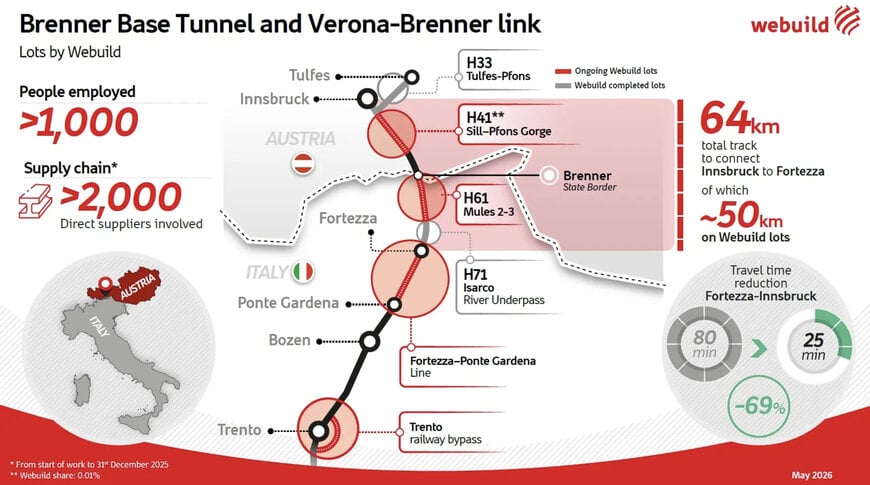
The Gardena Tunnel project forms part of the wider Brenner Base Tunnel system, which at 64 kilometres is expected to become the world’s longest underground railway tunnel upon completion.
Webuild is involved in approximately 50 kilometres of tunnel construction across four separate project lots on both the Italian and Austrian sides of the corridor. The company previously completed the Tulfes–Pfons section in Austria and the Isarco underpass project in Italy, while excavation of the Mules 2-3 section on the Italian side was completed in May 2025.
The Brenner Base Tunnel project is intended to transform transalpine transport by increasing rail freight capacity and strengthening sustainable transport infrastructure between Southern and Northern Europe.
Edited by Natania Lyngdoh, Induportals editor, with AI assistance.
www.webuildgroup.com
