
railway-international.com
14
'26
Written on Modified on
Lighting the Line: A Practical Proposal for Safer, Smarter Railway Platforms
Platform screen doors cost millions and suit few UK stations. There may be a simpler answer.
ivisionuk.com
Platform safety remains one of the most persistent challenges across the railway network. The industry has made substantial investment in signalling, staff training, and operational controls, yet the interface between train and passenger — the Platform Train Interface (PTI) — continues to account for a significant proportion of serious harm. The Rail Safety and Standards Board (RSSB) has described the PTI as accounting for around half of passenger fatality risk on the UK mainline network, with approximately 1,500 PTI incidents recorded annually.
Railway staff working near the track benefit from rigorous training and certification, supported by signalling systems engineered to mitigate risk at every stage. Passengers, by contrast — who may stand close to trains operating on routes with line speeds of up to 125mph (200km/h) — rely primarily on announcements, static signage, and tactile paving. For passengers with hearing impairments, reduced mobility, or limited situational awareness, even these cues may be insufficient.
Platform edge screen doors are frequently cited as a solution, and their effectiveness in controlled metro environments is well established. However, their adoption across the broader UK network faces substantial barriers. Retrofitting existing stations with platform screen doors can involve very high capital costs — comparable European and North American programmes have cited figures ranging from around €2.6 million per station for half-height installations to over €10 million where historic infrastructure complicates the work — along with significant civil and signalling integration, and compatibility challenges with mixed rolling stock. The variability of door positions across the UK network makes full-height platform barriers impractical at many legacy stations. A more adaptable, lower-cost intervention therefore merits serious consideration.
A Visual Safety Language at Platform Level
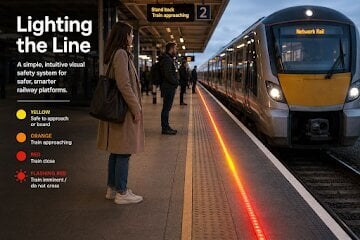
This proposal centres on a straightforward but potentially significant idea: an in-ground linear lighting strip installed approximately one metre back from the platform edge, operating as a dynamic visual cue that communicates real-time safety information directly to passengers. The concept draws on the same intuitive logic as road traffic signals — a language of colour that requires no literacy, no hearing, and minimal prior knowledge to interpret. It is intended to complement, rather than replace, the tactile warning strips already used at many stations.
The lighting would operate on a clear, consistent colour sequence tied to train approach and departure:
- Yellow — platform clear; safe to stand at the edge or board
- Orange — train approaching; stand clear of the edge
- Red — train imminent; do not cross the line
- Flashing red — train passing at speed; remain well clear
For stopping services, the sequence would reverse as the train comes to rest, returning to yellow once it is safe to board. The visual language is designed to become familiar to regular travellers whilst remaining immediately legible to occasional users and visitors. Its ground-level position places it within the natural sightline of passengers looking towards the track, including those who may not be watching overhead displays or listening to announcements.
The flashing red state would require careful validation. UK accessibility guidance raises concerns around flashing lights for passengers with photosensitive conditions, meaning that flash frequency, intensity, and duty cycle would need to be tested as part of any formal trial. This should be treated as a design parameter rather than a barrier to the concept itself.
Engineering Practicality
From an engineering standpoint, the installation is relatively contained. A narrow channel — approximately 50mm wide by 50mm deep — could be routed into the platform surface to house the LED strip and associated low-voltage cabling. A 48V DC architecture would be consistent with common railway auxiliary power practice, subject to detailed electrical safety design.
Control units could be located remotely within station infrastructure, away from the platform edge. Integration with existing signalling systems would likely provide the preferred operational mode, allowing the lighting to respond automatically to train detection data already present in the network. At simpler sites, standalone local detection systems may also be possible, though any wireless functionality would require robust fail-safe design and formal safety validation.
The lighting output would need to be diffused to avoid direct glare whilst maintaining visibility across the platform, particularly during low-light conditions. This aligns with the broader principles contained within Network Rail station lighting guidance and associated British Standards covering illuminance and visual comfort.
Cost, Scalability, and Maintenance
One of the most compelling aspects of this approach is its potential scalability. Whilst no installed cost data yet exists for a system of this specific type, the likely capital cost sits in a fundamentally different category from full platform screen doors, which require mechanical barrier systems, precision train stopping arrangements, and substantial civil and signalling integration.
Maintenance requirements could be relatively modest if modular, sealed, rail-approved components were used, although this would need to be demonstrated through operational trials. Any maintenance access would still need to comply with standard railway possessions procedures.
Behavioural Impact and Passenger Experience
Beyond immediate safety, the system has potential to positively influence passenger behaviour at the platform edge. Clear, real-time visual cues can reduce the uncertainty that often underlies risky behaviour — standing too close to the edge, stepping forward before a train has fully stopped, or misjudging a train’s approach speed. By making the platform safety state visually explicit, the system shifts passenger decision-making from inference to direct response.
There is scope for the system’s parameters to be refined through staged trial deployments. Variables including colour intensity, transition timing, and flash frequency could be adjusted to identify the most effective combinations for different platform geometries, passenger volumes, and lighting conditions. Structured feedback from passengers, including those with accessibility needs, would be an essential part of any evaluation.
The Regulatory Pathway
Any deployment on the UK mainline network would engage an established regulatory framework. RIS-3703-TOM — Passenger Train Dispatch and Platform Safety Measures — already requires Platform Safety and Train Dispatch Risk Assessments for changes affecting platform safety arrangements. This provides a natural framework within which a system of this type could be evaluated.
For a genuinely novel safety intervention, the likely pathway to acceptance would involve the Common Safety Method for Risk Evaluation and Assessment (CSM-RA), supported where necessary by independent assessment. The process exists specifically to evaluate new infrastructure and operational safety measures against defined risk criteria.
The proposal also aligns with existing RSSB PTI safety priorities, including ongoing industry focus on platform edge safety and passenger awareness campaigns such as Respect the Edge. A structured pilot deployment designed to generate operational and behavioural evidence would represent the logical next step.
A Step Toward Smarter Platforms
This proposal should be viewed as a concept for evaluation rather than a proven safety intervention. However, as the railway continues to modernise, incremental innovations grounded in engineering practicality and passenger psychology may play a meaningful role in reducing harm at the PTI.
In-ground dynamic lighting does not compete with investment in signalling, rolling stock, or station infrastructure. Instead, it operates alongside them at the precise point where passengers and trains interact. Making safety visible — literally underfoot — at the moment it matters most is a simple idea that may prove capable of delivering meaningful behavioural and safety benefits.
www.ivisionuk.com
The flashing red state would require careful validation. UK accessibility guidance raises concerns around flashing lights for passengers with photosensitive conditions, meaning that flash frequency, intensity, and duty cycle would need to be tested as part of any formal trial. This should be treated as a design parameter rather than a barrier to the concept itself.
Engineering Practicality
From an engineering standpoint, the installation is relatively contained. A narrow channel — approximately 50mm wide by 50mm deep — could be routed into the platform surface to house the LED strip and associated low-voltage cabling. A 48V DC architecture would be consistent with common railway auxiliary power practice, subject to detailed electrical safety design.
Control units could be located remotely within station infrastructure, away from the platform edge. Integration with existing signalling systems would likely provide the preferred operational mode, allowing the lighting to respond automatically to train detection data already present in the network. At simpler sites, standalone local detection systems may also be possible, though any wireless functionality would require robust fail-safe design and formal safety validation.
The lighting output would need to be diffused to avoid direct glare whilst maintaining visibility across the platform, particularly during low-light conditions. This aligns with the broader principles contained within Network Rail station lighting guidance and associated British Standards covering illuminance and visual comfort.
Cost, Scalability, and Maintenance
One of the most compelling aspects of this approach is its potential scalability. Whilst no installed cost data yet exists for a system of this specific type, the likely capital cost sits in a fundamentally different category from full platform screen doors, which require mechanical barrier systems, precision train stopping arrangements, and substantial civil and signalling integration.
Maintenance requirements could be relatively modest if modular, sealed, rail-approved components were used, although this would need to be demonstrated through operational trials. Any maintenance access would still need to comply with standard railway possessions procedures.
Behavioural Impact and Passenger Experience
Beyond immediate safety, the system has potential to positively influence passenger behaviour at the platform edge. Clear, real-time visual cues can reduce the uncertainty that often underlies risky behaviour — standing too close to the edge, stepping forward before a train has fully stopped, or misjudging a train’s approach speed. By making the platform safety state visually explicit, the system shifts passenger decision-making from inference to direct response.
There is scope for the system’s parameters to be refined through staged trial deployments. Variables including colour intensity, transition timing, and flash frequency could be adjusted to identify the most effective combinations for different platform geometries, passenger volumes, and lighting conditions. Structured feedback from passengers, including those with accessibility needs, would be an essential part of any evaluation.
The Regulatory Pathway
Any deployment on the UK mainline network would engage an established regulatory framework. RIS-3703-TOM — Passenger Train Dispatch and Platform Safety Measures — already requires Platform Safety and Train Dispatch Risk Assessments for changes affecting platform safety arrangements. This provides a natural framework within which a system of this type could be evaluated.
For a genuinely novel safety intervention, the likely pathway to acceptance would involve the Common Safety Method for Risk Evaluation and Assessment (CSM-RA), supported where necessary by independent assessment. The process exists specifically to evaluate new infrastructure and operational safety measures against defined risk criteria.
The proposal also aligns with existing RSSB PTI safety priorities, including ongoing industry focus on platform edge safety and passenger awareness campaigns such as Respect the Edge. A structured pilot deployment designed to generate operational and behavioural evidence would represent the logical next step.
A Step Toward Smarter Platforms
This proposal should be viewed as a concept for evaluation rather than a proven safety intervention. However, as the railway continues to modernise, incremental innovations grounded in engineering practicality and passenger psychology may play a meaningful role in reducing harm at the PTI.
In-ground dynamic lighting does not compete with investment in signalling, rolling stock, or station infrastructure. Instead, it operates alongside them at the precise point where passengers and trains interact. Making safety visible — literally underfoot — at the moment it matters most is a simple idea that may prove capable of delivering meaningful behavioural and safety benefits.
www.ivisionuk.com
