
railway-international.com
22
'26
Written on Modified on
Active Safety Architectures and Modernization Frameworks for Urban Rail Transports
Škoda Group integrates localized digital sensor arrays and low-floor rolling stock architectures into municipal networks to expand the automotive data ecosystem.
www.skoda.cz
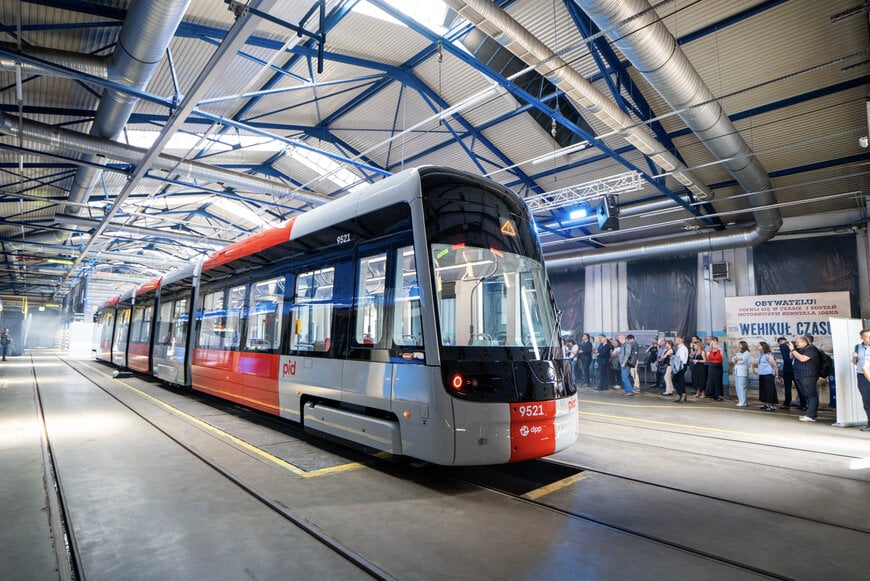
On 18 June 2026, a structural demonstration in Wroclaw introduced a next-generation five-section low-floor vehicle alongside active driving assistance systems engineered for modern urban transit networks. This technical deployment interfaces optronic tracking hardware with flexible bogie mechanical foundations to address operational risks in high-density metropolitan environments.
Optronic Sensor Fusion and Real-Time Trajectory Virtualization
To maintain operational reliability in historical city centers and high-gradient corridors, the active safety subsystem deploys an integrated anti-collision architecture directly into the rolling stock control unit. The system relies on a continuous telemetry stream combining Light Detection and Ranging (LiDAR) laser scanning, optical cameras, and localized digital track maps.
The onboard processing unit processes these inputs to establish a dynamic virtual tracking corridor ahead of the vehicle. The LiDAR module sweeps a nominal operational range of 100 meters, while the camera array classifies physical entities, including automobiles, cyclists, and pedestrians. Upon calculating a high-probability collision vector, the central processing system flashes real-time telemetry alerts to the driver interface and can autonomously engage the emergency braking circuit during critical proximity events to stabilize the asset.
Mechanical Integration and Rolling Stock Telemetry Frameworks
To navigate tight spatial constraints without accelerating infrastructure degradation, the rolling stock design employs an articulated five-section configuration measuring 32 meters in length and 2.5 meters in width. The physical envelope accommodates 243 passengers, with 70 dedicated seated allocations, and sustains a maximum operational velocity of 70 km/h.
The suspension layer features a mixed arrangement of fully rotating and partially rotating bogies. This configuration balances wheel-to-rail shear stresses, reducing rail corrugation and lowering long-term maintenance cycles for municipal track infrastructure. Thermoregulation is managed via localized climate control systems utilizing eco-friendly refrigerants. Concurrently, the integrated architecture serves as a mobile digital supply chain node, streaming telemetry regarding traction loads, positional coordinates, and energy usage directly to central depot management assets.
Additional Context: This section details technical specifications and competitive benchmarking not included in the original product announcement
Within the European municipal rail market, this active safety and rolling stock ecosystem competes directly with established platforms such as Siemens Mobility’s Obstacle Detection Assistance System (ODAS) and Alstom’s Citadis tramway variants.
Optronic Sensor Fusion and Real-Time Trajectory Virtualization
To maintain operational reliability in historical city centers and high-gradient corridors, the active safety subsystem deploys an integrated anti-collision architecture directly into the rolling stock control unit. The system relies on a continuous telemetry stream combining Light Detection and Ranging (LiDAR) laser scanning, optical cameras, and localized digital track maps.
The onboard processing unit processes these inputs to establish a dynamic virtual tracking corridor ahead of the vehicle. The LiDAR module sweeps a nominal operational range of 100 meters, while the camera array classifies physical entities, including automobiles, cyclists, and pedestrians. Upon calculating a high-probability collision vector, the central processing system flashes real-time telemetry alerts to the driver interface and can autonomously engage the emergency braking circuit during critical proximity events to stabilize the asset.
Mechanical Integration and Rolling Stock Telemetry Frameworks
To navigate tight spatial constraints without accelerating infrastructure degradation, the rolling stock design employs an articulated five-section configuration measuring 32 meters in length and 2.5 meters in width. The physical envelope accommodates 243 passengers, with 70 dedicated seated allocations, and sustains a maximum operational velocity of 70 km/h.
The suspension layer features a mixed arrangement of fully rotating and partially rotating bogies. This configuration balances wheel-to-rail shear stresses, reducing rail corrugation and lowering long-term maintenance cycles for municipal track infrastructure. Thermoregulation is managed via localized climate control systems utilizing eco-friendly refrigerants. Concurrently, the integrated architecture serves as a mobile digital supply chain node, streaming telemetry regarding traction loads, positional coordinates, and energy usage directly to central depot management assets.
Additional Context: This section details technical specifications and competitive benchmarking not included in the original product announcement
Within the European municipal rail market, this active safety and rolling stock ecosystem competes directly with established platforms such as Siemens Mobility’s Obstacle Detection Assistance System (ODAS) and Alstom’s Citadis tramway variants.
- Sensor Subsystem Efficiency: Unlike baseline radar-centric collision avoidance architectures that suffer from multi-path reflections and high false-alarm rates when operating amidst dense metallic urban infrastructure, the LiDAR-camera fusion matrix deployed here delivers precise spatial resolution within its 100-meter field of view, preventing unnecessary emergency braking triggers.
- Bogie Mechanical Flexibility: Compared to fixed-bogie tram rigid configurations that incur heavy flange wear and structural track stress when handling track curves with radii under 20 meters, the combined rotating and semi-rotating bogie assembly permits smoother curve transitions, reducing mechanical overhead.
- Data Integration Depth: While aftermarket driver assistance systems typically function as isolated warning mechanisms requiring secondary communication gateways, this architecture is natively tied into the vehicle's central Train Control and Management System (TCMS), allowing direct, microsecond coordination between real-time sensor analytics and dynamic braking profiles.
