
railway-international.com
23
'26
Written on Modified on
Flame-Retardant Composites for Additive Manufacturing in Rail Vehicle Construction
Stratasys expands its portfolio of industrial-grade thermoplastics for the on-demand production of certified rail vehicle components.
www.stratasys.com
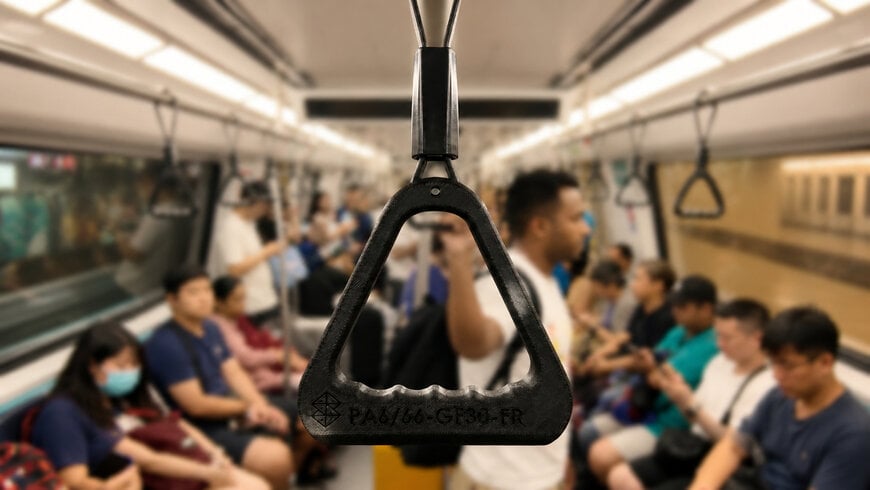
The introduction of a new, glass-fiber reinforced and flame-retardant composite material for industrial manufacturing systems addresses the demand for certified, production-ready solutions in the railway industry and transport sector. This material is engineered for the production of end-use parts and critical spare parts to optimize the digital supply chain through on-demand manufacturing.
Technical Validation and Norm Compliance in Transportation
The mechanical and regulatory requirements for components in rail vehicle construction demand a precise balance of durability and safety. The material is based on a polyamide-6/66 base polymer reinforced with a 30 percent weight fraction of glass fibers. This chemical composition achieves high stiffness and tensile strength, which are necessary for load-bearing, functional applications in rail transport. Its flame-retardant properties satisfy European safety regulations under the EN 45545-2 HL2 (R22/R23) standard as well as the automotive safety standard FMVSS 302, qualifying the material for use in passenger areas.
Optimization of Production Processes and Post-Processing
For industrial deployment on Fortus 450mc and F900 systems, repeatability of component quality is critical. The composite material offers high print stability and precise surface finish for complex geometries. Due to its compatibility with breakaway support structures, mechanical post-processing is simplified, increasing throughput in production environments. Alstom Group utilizes this technology within its spare parts management framework to implement controlled and certifiable production of qualified components with optimized post-processing cycles.
Lifecycle Management and On-Demand Spare Parts Supply
The transition to additive manufacturing in the transport sector addresses the logistical challenges of long-lived capital goods. Decentralized manufacturing eliminates high storage costs and long lead times for tool procurement, allowing components to be produced independently of traditional supply chains. Siemens Mobility deploys this additive process to increase flexibility in rail transport, improve maintenance efficiency, and optimize lifecycle management by manufacturing application-specific components on demand.
Additional Context: This section details technical specifications and competitive benchmarking not included in the original product announcement
Within additive manufacturing for the transport sector, the glass-fiber reinforced PA6/66-GF30-FR competes directly with established high-performance thermoplastics such as polycarbonate-based flame-retardant materials (PC-FR) and polyetherimide blends like ULTEM 9085 resin. Compared to PC-FR alternatives, the 30 percent glass-fiber reinforcement of this polyamide delivers significantly higher mechanical strength and dimensional stability under load. While ULTEM 9085 exhibits higher thermal resistance, the PA6/66 variant offers optimized chemical resistance to oils and solvents, alongside simplified support structure removal during processing for standardized railway applications under HL2 certification.
Edited by Sucithra Mani, Induportals editor – adapted by AI.
www.stratasys.com
