
railway-international.com
28
'26
Written on Modified on
Hitachi Rail Secures Supporting Systems Contract for Copenhagen S-Bane
Digital wayside infrastructure, passenger information, and automated platform obstacle detection systems will establish the operational foundation for unattended driverless suburban rail transit.
www.hitachirail.com
Stock image
DSB has awarded Hitachi Rail the Supporting Systems contract for the Future of S-Bane Programme to convert Copenhagen's regional passenger rail network into a fully automated transit system. The infrastructure contract provides the operational, surveillance, and passenger communication architecture required to transition 87 passenger stations to unattended train operation across Denmark's principal commuter transit corridor.
Wayside Safety Integration and Platform Obstacle Detection
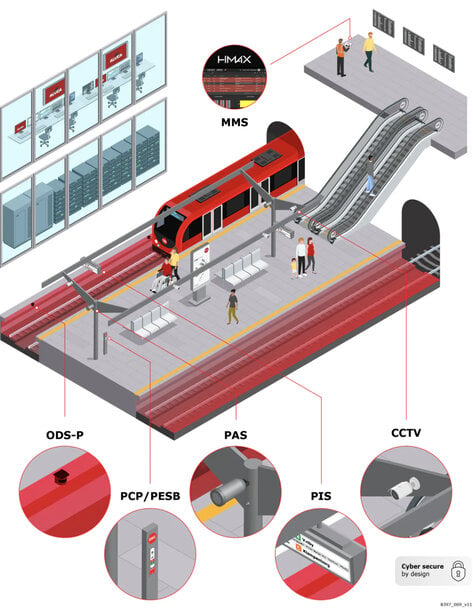
The technical scope of the Supporting Systems contract focuses on platform-to-track safety mechanisms necessary for driverless operations. The primary subsystem is the Platform Obstacle Detection System (ODS-P), an optical and sensory platform perimeter monitoring network deployed across station platform zones.
The ODS-P monitors platform edges and the immediate track area to detect the unauthorized entry of passengers, animals, or objects into the dynamic envelope of arriving trains. When an intrusion occurs, the detection architecture delivers telemetry signals directly to central train control and station safety systems, initiating automated deceleration or braking sequences while preventing trains from entering or departing affected station zones. By automating hazard identification without relying on onboard human observation, the system establishes the wayside risk-mitigation layer required for Grade of Automation 4 (GoA4) standards.
Digital Architecture and Operational Decision Support
Beyond platform hazard monitoring, the contract integrates operational telemetry, passenger communications, and asset management platforms into an interconnected digital framework:
Industrial networks and Supervisory Control and Data Acquisition (SCADA) systems integrate physical station infrastructure, power monitoring, and emergency systems into the central operating control center.
Passenger-facing systems incorporate synchronized Public Address and Passenger Information Systems (PAS/PIS) alongside an updated Closed-Circuit Television (CCTV) analytical camera grid and physical platform emergency stop buttons (PESB).
Maintenance operations incorporate Hitachi Rail's HMAX digital asset management platform. HMAX processes sensor telemetry via machine learning algorithms to model predictive maintenance schedules for wayside electrical, digital, and mechanical assets, mitigating equipment failures prior to operational disruption.
Network Transition Toward Unattended Passenger Operation
The Copenhagen S-Bane encompasses 170 route kilometers serving approximately 350,000 daily passengers across seven lines. Implementing the Supporting Systems contract prepares physical stations for phased network migration from semi-automated operation (GoA2) with onboard train drivers to unattended train operation (GoA4). The modular infrastructure allows station hardware and data networks to validate interoperability before the commercial deployment of driverless trainsets.
Additional Context:
This section details technical specifications and competitive benchmarking not included in the original product announcement
Automated passenger rail operations are governed by International Electrotechnical Commission standards IEC 62290-1 and IEC 62290-2, which define Grade of Automation levels. GoA4 mandates unattended train operation where train dispatching, door closure, obstacle detection, and emergency handling execute without onboard personnel.
In driverless metro systems worldwide, platform safety typically relies on Physical Platform Screen Doors (PSDs), as seen on the Copenhagen Metro or Paris Métro Line 14, which physically isolate the trackway from the platform. However, applying PSDs across existing open-air suburban networks like the Copenhagen S-Bane presents severe civil engineering constraints, high structural wind loads, and costly rolling stock door-pitch alignment requirements.
To overcome these structural limitations without installing full physical doors, railway operators deploy sensor-based track-intrusion detection. Comparable implementations include platform track protection systems deployed across the Nuremberg U-Bahn (U2/U3 driverless lines) using high-frequency radar and infrared optical curtains, and platform surveillance solutions deployed by Thales (now part of Hitachi Rail) and Siemens Mobility using computer vision and 3D LiDAR.
Within the broader Future of S-Bane initiative, the Supporting Systems package interfaces directly with Siemens Mobility's Trainguard MT Communication-Based Train Control (CBTC) signaling contract, which manages automatic train protection and moving block separation. By validating platform clearance via wayside sensor arrays rather than vehicle-mounted sensors alone, the system reduces onboard computational loads and ensures fail-safe signal interlocks with the central interlocking architecture according to Safety Integrity Level 4 (SIL 4) requirements under CENELEC standard EN 50129.
Edited by Natania Lyngdoh, Induportals editor, assisted by AI.
www.hitachirail.com
DSB has awarded Hitachi Rail the Supporting Systems contract for the Future of S-Bane Programme to convert Copenhagen's regional passenger rail network into a fully automated transit system. The infrastructure contract provides the operational, surveillance, and passenger communication architecture required to transition 87 passenger stations to unattended train operation across Denmark's principal commuter transit corridor.
Wayside Safety Integration and Platform Obstacle Detection
The technical scope of the Supporting Systems contract focuses on platform-to-track safety mechanisms necessary for driverless operations. The primary subsystem is the Platform Obstacle Detection System (ODS-P), an optical and sensory platform perimeter monitoring network deployed across station platform zones.
The ODS-P monitors platform edges and the immediate track area to detect the unauthorized entry of passengers, animals, or objects into the dynamic envelope of arriving trains. When an intrusion occurs, the detection architecture delivers telemetry signals directly to central train control and station safety systems, initiating automated deceleration or braking sequences while preventing trains from entering or departing affected station zones. By automating hazard identification without relying on onboard human observation, the system establishes the wayside risk-mitigation layer required for Grade of Automation 4 (GoA4) standards.
Digital Architecture and Operational Decision Support
Beyond platform hazard monitoring, the contract integrates operational telemetry, passenger communications, and asset management platforms into an interconnected digital framework:
Industrial networks and Supervisory Control and Data Acquisition (SCADA) systems integrate physical station infrastructure, power monitoring, and emergency systems into the central operating control center.
Passenger-facing systems incorporate synchronized Public Address and Passenger Information Systems (PAS/PIS) alongside an updated Closed-Circuit Television (CCTV) analytical camera grid and physical platform emergency stop buttons (PESB).
Maintenance operations incorporate Hitachi Rail's HMAX digital asset management platform. HMAX processes sensor telemetry via machine learning algorithms to model predictive maintenance schedules for wayside electrical, digital, and mechanical assets, mitigating equipment failures prior to operational disruption.
Network Transition Toward Unattended Passenger Operation
The Copenhagen S-Bane encompasses 170 route kilometers serving approximately 350,000 daily passengers across seven lines. Implementing the Supporting Systems contract prepares physical stations for phased network migration from semi-automated operation (GoA2) with onboard train drivers to unattended train operation (GoA4). The modular infrastructure allows station hardware and data networks to validate interoperability before the commercial deployment of driverless trainsets.
Additional Context:
This section details technical specifications and competitive benchmarking not included in the original product announcement
Automated passenger rail operations are governed by International Electrotechnical Commission standards IEC 62290-1 and IEC 62290-2, which define Grade of Automation levels. GoA4 mandates unattended train operation where train dispatching, door closure, obstacle detection, and emergency handling execute without onboard personnel.
In driverless metro systems worldwide, platform safety typically relies on Physical Platform Screen Doors (PSDs), as seen on the Copenhagen Metro or Paris Métro Line 14, which physically isolate the trackway from the platform. However, applying PSDs across existing open-air suburban networks like the Copenhagen S-Bane presents severe civil engineering constraints, high structural wind loads, and costly rolling stock door-pitch alignment requirements.
To overcome these structural limitations without installing full physical doors, railway operators deploy sensor-based track-intrusion detection. Comparable implementations include platform track protection systems deployed across the Nuremberg U-Bahn (U2/U3 driverless lines) using high-frequency radar and infrared optical curtains, and platform surveillance solutions deployed by Thales (now part of Hitachi Rail) and Siemens Mobility using computer vision and 3D LiDAR.
Within the broader Future of S-Bane initiative, the Supporting Systems package interfaces directly with Siemens Mobility's Trainguard MT Communication-Based Train Control (CBTC) signaling contract, which manages automatic train protection and moving block separation. By validating platform clearance via wayside sensor arrays rather than vehicle-mounted sensors alone, the system reduces onboard computational loads and ensures fail-safe signal interlocks with the central interlocking architecture according to Safety Integrity Level 4 (SIL 4) requirements under CENELEC standard EN 50129.
Edited by Natania Lyngdoh, Induportals editor, assisted by AI.
www.hitachirail.com
