
railway-international.com
23
'26
Written on Modified on
High-Speed Rail Digital Signalling & Train Control Infrastructure
Hitachi Rail deploys digital interlocking and ETCS systems across the Ankara-Izmir corridor to reduce intercity transit duration to 3.5 hours.
www.hitachirail.com
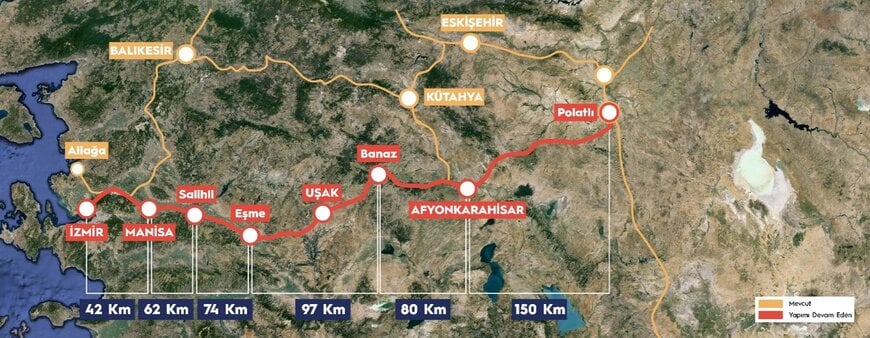
Conventional passenger and freight transport between central Anatolia and the Aegean coast has historically been constrained by circuitous legacy alignments, creating protracted transit schedules and highway bottlenecks. To establish a modern high-speed rail corridor, railway systems provider Hitachi Rail has secured a digital signalling contract from the Infrastructure Investment General Directorate (AYGM) to engineer, equip, and commission the train control architecture for the new Ankara-Izmir high-speed line.
Digital Signalling Architecture for High-Speed Passenger Corridors
High-speed mainline operations demand real-time telemetry, continuous train supervision, and fail-safe route reservation to permit safe headway spacing at elevated track speeds. The new high-speed rail line spans a 503-kilometre double-track corridor engineered for bi-directional running. Under the scope commissioned by the Ministry of Transport, Hitachi Rail is responsible for the design, equipment delivery, installation supervision, testing, and system commissioning across the route.
The infrastructure scope integrates trackside detection, dynamic wayside data transmission, and centralized control. The system includes:
- Computer-based electronic interlocking systems to manage switch routing and enforce signal interlocking logic without mechanical latency.
- Centralized Traffic Control (CTC) architectures that consolidate corridor-wide dispatching, track occupancy oversight, and route automation into a centralized operational control center.
- Point machines and high-integrity audio-frequency track circuits for wheel-rail occupancy detection and route boundary verification.
Implementation of Multi-Level ETCS Train Protection
To supervise running speeds up to 250 km/h, the line incorporates the European Train Control System (ETCS) across Level 1 and Level 2 architectures. ETCS provides automatic train protection (ATP) by continuously comparing actual train velocity against a computed dynamic braking curve.
In ETCS Level 1 operations, spot transmission occurs via track-mounted Eurobalises and lineside electronic units connected to line signals, passing movement authorities directly to the train's cab display. In ETCS Level 2 operations, digital radio communication via dedicated railway telecommunications networks (GSM-R) transmits continuous movement authorities from a trackside Radio Block Centre (RBC) directly to the on-board European Vital Computer (EVC), rendering traditional optical wayside signals redundant and allowing dynamic block management.
Operational and Regional Connectivity Impacts
Commissioning of the double-track high-speed rail line alters intercity transit economics across western Türkiye. Conventional rail journeys along the legacy network require 13 hours and 56 minutes between Ankara and Izmir. The introduction of 250 km/h electrified trainsets supervised by digital signalling compresses end-to-end journey times to approximately 3 hours and 30 minutes.
Beyond direct origin-destination traffic between the capital and the Aegean port hub, the 503-kilometre alignment establishes high-speed rail nodes for major provincial centers, including Afyonkarahisar, Uşak, and Manisa. The high-speed rail link serves as an east-west transit spine, relieving regional highway congestion and linking Aegean logistics infrastructure with the central national rail network.
Additional Context:
This section details technical specifications and competitive benchmarking not included in the original product announcement.
Mainline high-speed train control in Europe and neighboring interoperable networks is governed by the European Rail Traffic Management System (ERTMS) specifications under European Union Technical Specifications for Interoperability (TSI) for Control-Command and Signalling (TSI CCS). Under these frameworks, ETCS Level 2 requires continuous data exchange between on-board computers and trackside Radio Block Centres compliant with CENELEC safety integrity level 4 (SIL 4) standards under EN 50126, EN 50128, and EN 50129.
In international high-speed rail signalling, comparable turnkey digital control architectures are engineered by Alstom (Atlas ETCS suite), Siemens Mobility (Trainguard 200 ETCS system), and Thales/Hitachi GTS (Ground Transportation Systems). ETCS Level 2 architectures are benchmarked primarily on headway compression, radio hand-over latency across RBC boundaries, and balise positioning tolerance. While ETCS Level 1 relies on physical line-of-sight signal updates and fixed Eurobalises (typically spaced at intervals of 1 to 2 kilometres), ETCS Level 2 continuous radio transmission allows headway reductions of up to 30 to 40 percent compared to conventional automatic block signalling, optimizing overall corridor throughput.
Edited by Natania Lyngdoh, Induportals editor, with AI assistance.
www.hitachirail.com
