
railway-international.com
03
'26
Written on Modified on
Bogie Vibration Absorbers To Reduce Tram Infrastructure Vibrations
Stadler and HEAG mobilo test bogie vibration absorbers to technically dampen wheel rail contact vibrations across the local Darmstadt public transportation tram network.
stadlerrail.com
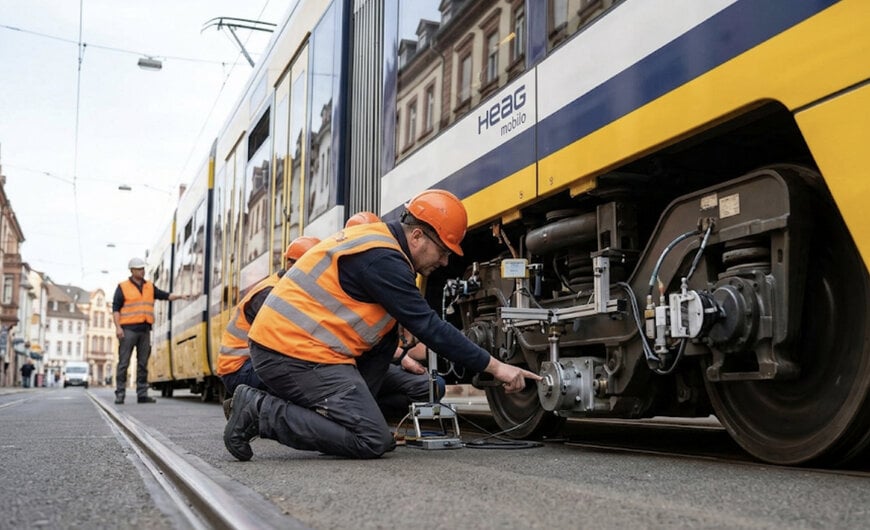
The integration of additional damping elements on tram bogies aims to minimise the transmission of vibrations to the track infrastructure and the surrounding environment. To overcome this infrastructural challenge in public transport, a new vehicle engineering solution is being tested during real network operations.
Industrial Challenge And Operational Context
Increased vibration levels have been documented in previous studies on certain sections of the tram network, particularly in the Eberstadt, Seeheim, and Arheilgen areas. The core technical challenge is to intercept the vibrations generated in the wheel rail contact directly at the source before they transfer to the entire system of vehicle, track, and subsurface. Effective damping is necessary to reduce the mechanical load on the infrastructure and guarantee stable network operations.
Technical Solution And Responsibilities
To address these parameters, Stadler Deutschland and HEAG mobilo are equipping a vehicle from the Darmstadt fleet with additional vibration absorbers for the first time. These components are mounted directly onto the tram bogies as supplementary parts to physically dampen specific resonance frequencies. Parallel to the implementation of the vibration absorbers, the partners are executing further vehicle engineering optimisations. Updated vehicle software adjusts the propulsion and braking behaviour to suit autumnal weather conditions, while accessibility is modified through the installation of flexible folding ramps at the doors.
Deployment And Implementation
The technical deployment will commence in early November with test runs across the route network to calibrate the final parameters on the absorber before the actual measurement runs. In mid November, systematic vibration measurements will be conducted at the selected critical locations. Data collection involves a metrological comparison between a vehicle equipped with vibration absorbers and unmodified vehicles from the fleet. Regarding the objectives of these vehicle modifications, Ansgar Brockmeyer, Deputy Group CEO at Stadler, explained that they now want to examine together with HEAG mobilo what contribution this technical solution can also make to reducing vibrations in Darmstadt.
Results And Expected Impacts
The ongoing measurement campaign provides the data foundation to fine tune the function of the absorber during real operations and optimise its effectiveness. Following the completion of the test runs, Stadler and HEAG mobilo will jointly evaluate the telemetric and mechanical results. Discussing the metrological target values of the implementation, Johannes Gregor, Managing Director of HEAG mobilo, stated that they expect the technical advancements on the vehicle to lead to a demonstrable reduction in vibrations, and this is how they will measure the success of the upcoming tests.
Edited by Maria Brueva, Induportals editor - adapted by AI.
www.stadlerrail.com
