
railway-international.com
04
'26
Written on Modified on
Alstom Traxx Passenger launches Romania’s first ETCS Level 2 service
The locomotive combines onboard signalling with trackside infrastructure, advancing railway safety, interoperability and cross-border connectivity on the Bucharest–Budapest corridor.
www.alstom.com
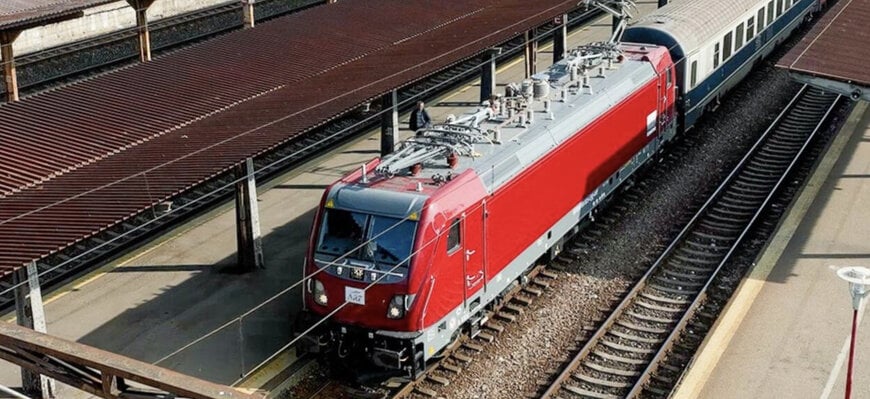
Cross-border railway corridors in Central and Eastern Europe face persistent throughput bottlenecks caused by legacy national signaling systems, which require complex wayside light signaling and manual driver observation. To transition from fragmented national networks to a unified digital rail architecture, smart mobility provider Alstom has commenced Romania’s first commercial passenger service operating under the European Train Control System Level 2. Operating on the line between Buftea and Brazi along the Bucharest to Budapest rail axis, the deployment pairs Alstom Traxx Passenger electric locomotives with wayside digital signaling infrastructure to continuously regulate train operations, enforce line speed limits, and establish seamless interoperability with the wider European network.
Signaling Fragmentation and Infrastructure Challenges in European Rail
European rail networks historically developed around isolated national train protection systems, compelling cross-border trains to carry multiple onboard safety computers or require engine changes at national borders. In conventional operation, line-of-sight optical signals dictate permissible speeds and track clearances, exposing operations to human reaction variance and requiring substantial headway margins between rolling stock.
Modernizing conventional lines to support elevated passenger frequencies demands a harmonized digital architecture. The European Rail Traffic Management System standard addresses this operational bottleneck by migrating signaling data from physical trackside light indicators to digital cab signaling. On Romania’s busy transport corridors—specifically trunk routes linking Bucharest toward Western Europe—upgrading track infrastructure requires rolling stock capable of dynamically transitioning between conventional national signaling mechanisms and continuous digital supervision without disrupting existing service timetables.
Engineering Mechanism and Architecture of ETCS Level 2
Unlike Level 1 architectures that depend on intermittent trackside balise transmissions at fixed signals, ETCS Level 2 operates as a radio-based, continuous train supervision system. The trackside Radio Block Centre interfaces directly with electronic interlocking systems to monitor track occupancy and determine route reservations. Movement authorities—specifying safe operating distances and dynamic deceleration profiles—are generated by the Radio Block Centre and transmitted continuously to the locomotive via GSM-R digital telecommunications networks. Passive Eurobalises mounted on the track sleepers provide absolute geographic positioning references to calibrate the locomotive’s onboard odometry sensors.
Onboard the Traxx Passenger locomotive, the Alstom Onvia Cab signaling suite manages real-time system execution. At the core of the suite is the European Vital Computer, a safety-critical processing unit that continuously balances current train velocity and train weight against the transmitted movement authority curve. If the train approaches an occupied section or exceeds the programmed dynamic speed limit, the onboard system displays visual and acoustic braking warnings on the Driver Machine Interface in the cab. Failure by the train driver to intervene triggers automatic electro-pneumatic service or emergency braking to prevent signal overruns and buffer collisions.
Fleet Deployment and Corridors Across Romania
The initial ETCS Level 2 passenger deployment operates under a contract with the Romanian Railway Reform Authority (ARF) covering 16 Traxx Passenger electric locomotives. Delivered to Romania by April 2026, the locomotives were phased into commercial operation beginning September 2026 under legacy signaling systems to validate tractive performance before activating Level 2 radio supervision on the Buftea to Brazi corridor. All 16 contracted units have completed physical delivery to the country.
According to Laurentiu Ivan, Alstom Managing Director for Romania, Bulgaria, and the Republic of Moldova, the implementation of ETCS in Romania represents a fundamental step in modernizing safety and interoperability, demonstrating how coordinated investment in rolling stock and digital trackside infrastructure establishes a connected railway system for passengers.
The current commercial service builds on Alstom's previous infrastructure installations, including the country's first ETCS Level 2 deployment along the rehabilitated Border–Curtici–Arad–Km. 614 section and the automated traffic management centre in Arad. Subsequent automated traffic control facilities are designated for Simeria, Brasov, Cluj-Napoca, Bucharest, and Craiova. Alstom’s current portfolio encompasses ETCS Level 2 track installations across the Northern branch of the Rhine-Danube corridor, two lots on the Cluj–Oradea line, the Caransebes–Lugoj section, the Craiova–Caransebes corridor, and the historic Bucharest–Giurgiu link.
Additional Context:
This section details technical specifications and competitive benchmarking not included in the original product announcement.
The Alstom Traxx platform—originally developed across TRAXX AC, MS, and DC iterations by Bombardier Transportation prior to its acquisition by Alstom—represents one of Europe’s predominant electric locomotive architectures, with over 6,000 units delivered worldwide. Traxx passenger and multi-system platforms typically feature a four-axle Bo-Bo configuration, delivering continuous power outputs between 5.6 MW and 6.4 MW (7,500 to 8,600 hp) driven by water-cooled IGBT traction converters and three-phase asynchronous induction motors. Designed to meet European Technical Specifications for Interoperability (TSI), the passenger variants are rated for operational top speeds between 160 km/h and 200 km/h with starting tractive effort ratings reaching 300 kN.
In the European mainline locomotive segment, the Traxx platform competes directly against the Siemens Mobility Vectron and the Stadler EURO9000. While the Siemens Vectron platform utilizes Siemens Trainguard 200 ETCS onboard systems with Baseline 3 specifications and modular multi-system voltage packages (15 kV AC, 25 kV AC, 1.5 kV DC, 3 kV DC), Alstom’s Traxx utilizes the Onvia Cab package (formerly branded under the Atlas ETCS product line), which conforms to UNISIG ERTMS/ETCS Baseline 3 Release 2 standards. ETCS Level 2 operations eliminate trackside color-light signals, permitting trains to safely run at tighter headways and higher design speeds compared to conventional Level 1 or national automatic train stop systems (such as PZB/INDUSI), supporting cross-border operations compliant with European Union Directive 2016/797 on rail interoperability.
Edited by Natania Lyngdoh, Induportals editor, with AI assistance.
www.alstom.com
