
railway-international.com
13
'26
Written on Modified on
HBK integrates railway track and rolling stock condition monitoring
The sensor-to-decision ecosystem uses fiber-optic telemetry and AI to enable predictive maintenance for modern railways.
www.hbkworld.com
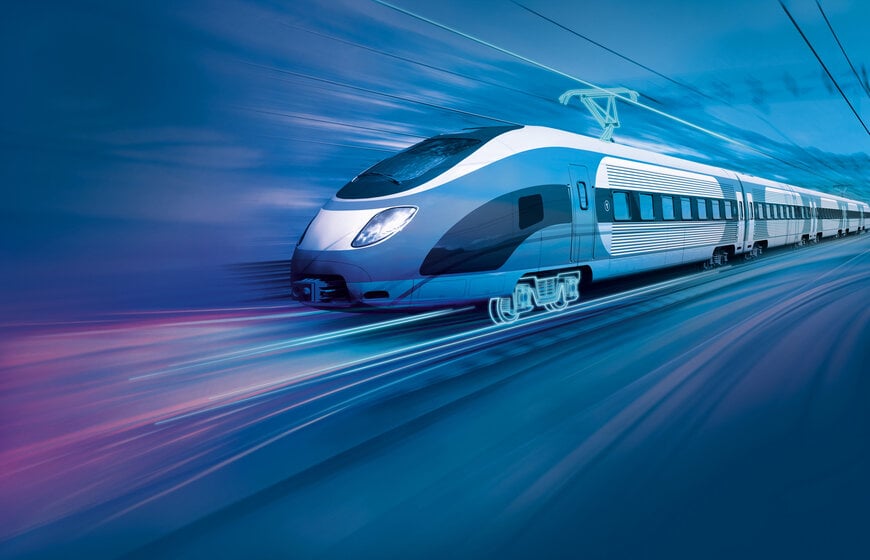
Hottinger Brüel & Kjær (HBK) has launched an integrated condition monitoring strategy designed to bridge the historically siloed domains of railway track infrastructure and rolling stock performance. By linking advanced hardware sensors directly to real-time, AI-enabled analytical engines, the company aims to help railway engineers transition from disjointed, reactive measurements to true predictive decision-making. This unified approach eliminates isolated data pools, significantly reducing overlooked maintenance flags, early component failures, and unnecessary service delays.
A connected sensor-to-decision ecosystem
The cornerstone of HBK’s approach is the consolidation of critical on-track and onboard nodes into a single, high-definition operational view. On the infrastructure side, the Argos newLight Wayside Train Monitoring system utilizes state-of-the-art fiber-optic sensing to continuously track vital metrics under harsh physical environments. These include Weigh-in-Motion (WIM), Wheel Impact Load Detection (WILD), and Out-of-Roundness (OOR) measurements. Simultaneously, unattended onboard measurement systems monitor rolling stock health directly on active fleets, capturing dynamic wear-and-tear and ride comfort. Furthermore, precision Structural Health Monitoring (SHM) sensors track the integrity of critical tunnels and bridge structures to detect structural displacement or stress before safety margins are compromised.
Transforming raw telemetry into actionable intelligence
To bridge the gap between hardware and software, these high-fidelity raw data streams are compiled into the Monitor 360 analytical platform. When combined with ReliaSoft’s asset lifecycle analysis, maintenance teams can accurately forecast failure windows and optimize fleet deployment. As Dietmar Maicz, Country Manager Austria at HBK, notes, modern railways cannot afford to look at vehicles and tracks in isolation. An imperfect wheel inherently compromises track integrity, just as a degraded track accelerates wheel wear. By unifying these data pools, operators can significantly extend asset lifespans and drastically reduce operational overhead.
Additional Context:
This section details the photonics of fiber-optic strain sensing and railway wheel mechanics not included in the original press release.
In harsh railway environments, traditional electrical strain gauges are highly susceptible to electromagnetic interference (EMI) from high-voltage overhead catenary lines and traction motors, as well as degradation from extreme weather. The Argos newLight system overcomes this by utilizing Fiber Bragg Grating (FBG) optical sensors. An FBG is a microscopic periodic variation etched directly into the core of an optical fiber. When a broadband light beam is fired down the fiber, the grating reflects a specific wavelength of light (the Bragg wavelength) and transmits the rest. As a heavy train passes over the track, the rail physically deforms, microscopically stretching the attached fiber. This physical strain alters the grating's spacing, proportionally shifting the reflected wavelength. By measuring this nanometer-scale shift at the speed of light, the interrogator can calculate the exact mechanical strain on the rail with absolute immunity to electrical noise.
This extreme precision is vital for Wheel Impact Load Detection (WILD). Railway wheels can develop "flat spots" from heavy braking or sliding on the rail. When a flat spot strikes the rail head at high speeds, it generates a massive dynamic impact load—often several times the static weight of the train car. These high-frequency shockwaves exponentially accelerate the fatigue and micro-cracking of both the wheel bearing and the steel rail infrastructure. High-speed FBG sensors can detect these specific dynamic impact signatures in real-time, allowing operators to flag and pull specific rolling stock for wheel truing before catastrophic derailments or infrastructure damage occurs.
Edited by an industrial journalist, Lekshman Ramdas, with AI assistance.
www.hbkworld.com
