
railway-international.com
24
'26
Written on Modified on
Škoda Group secures major tram order in Germany
With a new major order for modern low-floor trams for Essen, Krefeld and Oberhausen, Škoda Group is strengthening its position in one of its strategic markets.
www.skoda.cz
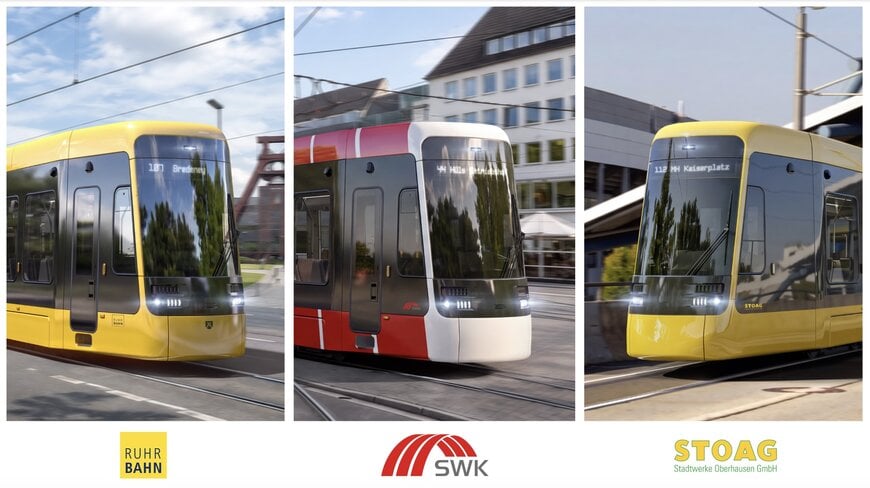
Municipal transit operators across Germany’s densely populated Rhine-Ruhr metropolitan region face mounting pressure to replace aging high-floor and early-generation low-floor tram fleets while navigating tight urban street geometries, steep gradients, and mixed-traffic intersections. Procuring bespoke light rail vehicles independently for each municipality drives up engineering costs, fragments spare-parts inventories, and extends homologation timelines. At the same time, neighboring operators often run on different track gauges, power supply configurations, and onboard signaling architectures, making simple off-the-shelf procurement impractical. Overcoming these operational and economic hurdles requires joint municipal procurement built upon a standardized modular tram platform that accommodates operator-specific subsystems while integrating active collision avoidance and step-free passenger accessibility.
Modular Bidirectional Platform Tailored for Three Rhine-Ruhr Operators
To modernize urban rail fleets across three major Rhine-Ruhr cities, Škoda Group secured an order for up to 79 modern low-floor bidirectional trams from municipal transport operators Ruhrbahn GmbH (Essen), SWK MOBIL GmbH (Krefeld), and STOAG Stadtwerke Oberhausen GmbH (Oberhausen). Built on a shared modular vehicle architecture, the fleet will be delivered in two length configurations—approximately 30 meters and 38 meters—providing passenger capacities ranging between 170 and 230 travelers depending on interior layout.
Standardizing on a common platform streamlines spare-parts logistics, workshop maintenance, and driver training across the three operators, while allowing bespoke customization of traction power interfaces, communications hardware, passenger information systems, and wayside infrastructure integration. Engineered for demanding inner-city streetcar alignments, the vehicles negotiate tight curve radii down to 17 meters, climb gradients of up to 7.5 percent, and achieve a top operating speed of 70 kilometers per hour. Wide double-leaf doors and spacious multi-purpose zones ensure step-free boarding and onboard comfort for passengers with reduced mobility, strollers, and bicycles.
Active Urban Safety Systems and Expanding German Market Footprint
Designed for a 30-year operational service life with bundled technical support and lifecycle services, the new trams incorporate advanced active safety electronics tailored for dense street-running traffic. Onboard systems include a latest-generation anti-collision assistance suite alongside an intelligent speed limiter to mitigate intersection hazards and enhance operational safety.
With the addition of Essen, Krefeld, and Oberhausen, Škoda Group trams will operate across 14 German cities—joining existing deployments in Mannheim, Heidelberg, Ludwigshafen, Bonn, Kassel, Mainz, Chemnitz, Cottbus, and Frankfurt (Oder)—bringing the manufacturer’s total German tram order book and installed base to nearly 400 vehicles, including market leadership across Germany’s 1,000-millimeter meter-gauge networks.
Additional Context
This section details technical specifications and competitive benchmarking not included in the original product announcement.
In German light rail engineering governed by BOStrab (Verordnung über den Bau und Betrieb der Straßenbahnen) and EN 15227 crashworthiness standards, joint procurements across neighboring Rhine-Ruhr operators (such as the Rhein-Neckar-Verkehr joint model or the Essen–Krefeld–Oberhausen consortium) balance multi-city economies of scale against legacy infrastructure constraints. Notably, Essen (Ruhrbahn) and Oberhausen (STOAG) operate on 1,000-millimeter meter-gauge track networks—requiring compact bogie geometries capable of navigating 17-meter radii without excessive wheel-flange wear—and utilize Škoda’s ForCity Classic / ForCity Smart modular multi-articulated architectures with pivoting or low-floor bogies. Modern BOStrab safety compliance increasingly integrates radar, LiDAR, and stereo-camera obstacle detection (anti-collision systems) directly into the traction and electro-hydraulic braking control loop, automatically triggering audible warnings or emergency service braking if pedestrians or vehicles enter the dynamic kinematic envelope.
Within the German and Central European low-floor tram market, Škoda Group benchmarks directly against Siemens Mobility (Avenio), Alstom (Citadis and Flexity series), Stadler Rail (Tina and Tramlink), and CAF (Urbos). While Siemens’ Avenio and Alstom’s Flexity hold large installed bases across major German standard-gauge networks (such as Munich, Berlin, and Frankfurt), Škoda Group has captured a dominant share of Germany’s meter-gauge and joint regional procurements—leveraging flexible modular body lengths, pivoting bogie ride quality, and customizable electrical architectures to scale rapidly across mid-sized and metropolitan German transit authorities.
Edited by Romila DSilva, Induportals Editor, with AI assistance.
www.skodagroup.com
