
DC Power Systems for Critical Networks
The electrical protection of equipment and critical infrastructures is essential due to the very nature of these assets, which are of utmost importance for the economy and society.
www.salicru.com
The safety of people is always the most important reason, above economic and reputational aspects, as well as environmental and other considerations.
Alongside a growing awareness of the need for top-level protection, one of the most significant developments in recent years has been the unprecedented expansion of communication and data networks. This growth is currently being amplified by the widespread use of artificial intelligence (AI), which has driven the construction of massive data centres equipped with vast numbers of electronic devices.
Cloud and edge
The architecture used to process the enormous volume of data generated and transmitted by these networks can be either centralised or distributed. We therefore speak of a cloud or edge structure, the choice of which depends on factors such as where the data is generated, the required response speed, scalability, resilience and security.
Both share the fact that the starting point is the electrical grid (AC), while equipment and devices in telecommunications systems and data centres operate on DC, hence the need for AC>DC conversion. However, conversion and protection can be approached in two ways.
The first involves using an Uninterruptible Power Supply (UPS) that stores energy in a battery, thus performing the aforementioned AC>DC conversion. The role of the UPS is to supply stable, clean and continuous DC power, even when incidents occur in the electrical grid. These incidents range from common disturbances such as outages, harmonics, overvoltages or oscillations, to total power failure, in which case the UPS continues to supply energy.
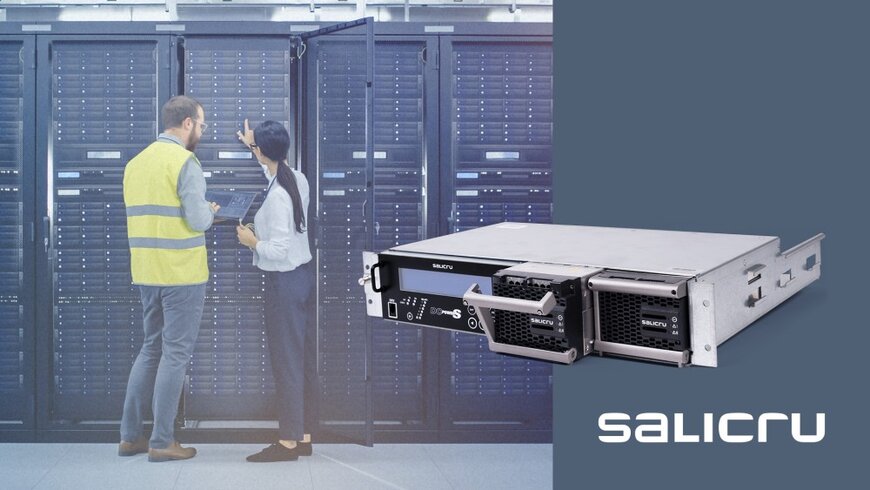
In telecommunications and edge data centre environments, a second option is to use a pure DC architecture, i.e. DC power systems that also protect and ensure the operation of these critical infrastructures. These systems incorporate redundancy and are characterised by their modularity, allowing them to be expanded according to requirements in order to optimise investment.
Their most common applications include fixed and mobile communication networks, railway infrastructures, edge data centres and substations. Extreme reliability, high immunity to disturbances and robustness, together with comprehensive integrated monitoring via communication modules, are some of the features of DC power systems for the railway environment, where signalling and control equipment cannot tolerate failure. In substations and edge data centres, other factors such as low consumption, modularity and compact size are also highly valued.
Edge solutions are implemented locally, and therefore their scale requires a different approach from that of cloud infrastructure, which is based on large data centres. Both models coexist in a continuously growing market; however, each has specific requirements in terms of power supply and protection, which UPS systems and DC power systems are well equipped to meet.
www.salicru.com
