
railway-international.com
12
'26
Written on Modified on
Publication of Initial Network Statement for Baltic Railway Infrastructure
Rail Baltica releases its first network statement framework to outline technical and operational conditions for railway operators.
www.railbaltica.org
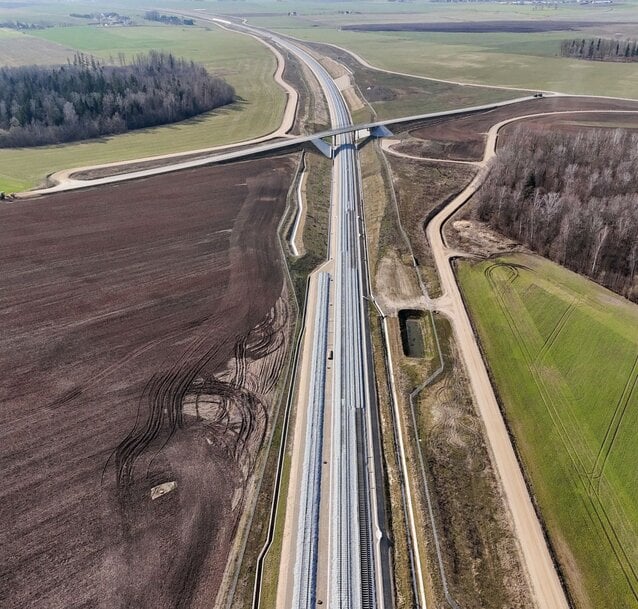
Rail Baltic Estonia, Eiropas Dzelzceļa līnijas, and LTG Infra, in cooperation with coordinator RB Rail AS, have published the first version of the Network Statement for the Rail Baltica project. Prepared in accordance with the RailNetEurope framework, the document provides an initial consolidated overview of the technical, operational, and access conditions for the cross-border railway spanning Estonia, Latvia, and Lithuania.
Technical Infrastructure and Communications Architecture
Rail Baltica is constructed as a 1,435 mm standard-gauge railway designed to support operational speeds of up to 249 km/h. To enable these speeds and ensure cross-border interoperability, the infrastructure integrates the European Rail Traffic Management System (ERTMS) Level 2 alongside the Future Railway Mobile Communication System (FRMCS). The railway forms a critical segment of both the North Sea-Baltic and the Baltic Sea-Black Sea-Aegean Sea Trans-European Transport Network (TEN-T) corridors, facilitating seamless passenger and freight transport integration with the wider European rail network.
Regulatory Framework and Capacity Allocation
The initial publication functions as an informational reference framework establishing a structured operational baseline for future railway undertakings. While Version 1 does not currently constitute a formal basis for track capacity applications, subsequent editions will expand to include comprehensive chapters on capacity allocation, charging principles, and formal operational procedures as mandated by European regulations. A separate regulatory network statement governing the Polish section of the railway will be published independently by PKP Polskie Linie Kolejowe (PKP PLK).
Additional Context: This section details technical specifications and competitive benchmarking not included in the original announcement
Under European Union Directive 2012/34/EU, the publication of a Network Statement is a mandatory regulatory requirement for all railway infrastructure managers. It ensures transparent, non-discriminatory access to track capacity for both private and state-owned rail operators. Furthermore, the implementation of ERTMS Level 2 paired with the 5G-based FRMCS standard eliminates the need for traditional trackside optical signals. Instead, movement authorities and speed restrictions are transmitted continuously via wireless data directly to the train's onboard computer. This digital signaling architecture is a strict technical necessity for maintaining safe braking distances and high-density traffic flow at the planned 249 km/h operating speeds.
Edited by Lekshman Ramdas, Induportals editor – adapted by AI.
www.railbaltica.org
