
railway-international.com
18
'26
Written on Modified on
Hitachi Rail modernises signalling systems on the Hamburg–Berlin line
Hitachi Rail has updated the signalling and train control systems along the Paulinenaue–Schwanheide section to optimize corridor reliability for DB InfraGO AG.
www.hitachirail.com
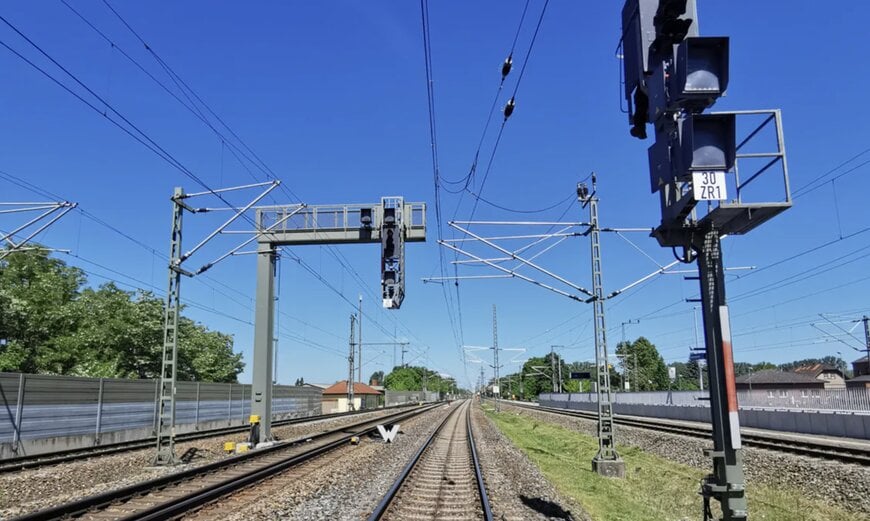
The reopening of the Hamburg–Berlin rail line has updated one of Germany’s primary rail connections, enhancing performance and reliability across the corridor. As a technology partner to DB InfraGO AG, Hitachi Rail renewed the signalling and train control infrastructure along the approximately 200-kilometer section connecting Paulinenaue and Schwanheide to support high-volume passenger and freight transport.
Train Control Signalling and Corridor Modernisation
The comprehensive infrastructure project brought the route's train control systems up to modern technological standards. These upgraded systems permit precise control of train movements along the highly utilised high-performance corridor, creating a stable operational foundation capable of managing high long-term traffic volumes.
The upgrading of such critical European corridors requires precise structural planning, field execution, and integration into active line management processes. The successful implementation of these systems within a central transport link was achieved through close coordination between Hitachi Rail, the client, and project stakeholders.
Strategic Integration and ESTW L90 Hardware
The Hamburg–Berlin line modernisation forms part of Germany’s nationwide program to renew high-performance rail corridors, aligning with the objectives of the Trans-European Transport Network (TEN-T). The program aims to scale track capacity on key routes and reinforce rail networks as a primary component of sustainable mobility.
To prepare the railway infrastructure for future operational requirements, the project deployed technical solutions including the ESTW L90 electronic interlocking system running on a modernized hardware platform.
Additional Context
This section details technical specifications not included in the original news release.
Modern high-speed rail corridors rely on electronic interlocking systems (Elektronisches Stellwerk, or ESTW) and advanced train control frameworks to maximize line capacity while ensuring safety. Traditional relay-based interlocking systems use complex networks of hardwired copper circuits to mechanically and electrically prevent conflicting route allocations. In contrast, electronic interlocking systems like the ESTW L90 utilize a decentralized, software-driven architecture. Highly redundant microprocessors execute fail-safe Boolean logic operations to control track elements such as points, signals, and axle counters, reducing trackside wiring bulk and accelerating response times.
The ESTW L90 system interfaces directly with train control layers to enforce safe separation between vehicles moving at high velocities. On major European corridors, this is increasingly managed via the European Train Control System (ETCS). Under ETCS Level 2, traditional physical line-of-sight signals are replaced by cab signalling inside the train cockpit.
The trackside electronic interlocking system continuously transmits movement authorities, permissible line speeds, and track topology data directly to the train’s onboard computer via a dedicated GSM-R wireless communications network. Balises placed between the rails act as passive transponders, calibrating the train's precise odometer measurements as it passes over them. The onboard computer processes these parameters in real time, calculating dynamic deceleration curves to automatically apply the brakes if a train approaches its safety limit, thereby safely narrowing the headway between sequential trains to optimize overall corridor throughput.
Edited by Romila DSilva, Induportals Editor, with AI assistance.
www.hitachirail.com
