
railway-international.com
30
'26
Written on Modified on
Class 99 Hybrid Locomotive Enters UK Freight Service
GB Railfreight launched the first commercial Class 99 hybrid freight locomotive service, combining electric and renewable-fuel operation to reduce emissions while maintaining nationwide network access.
www.gbrailfreight.com
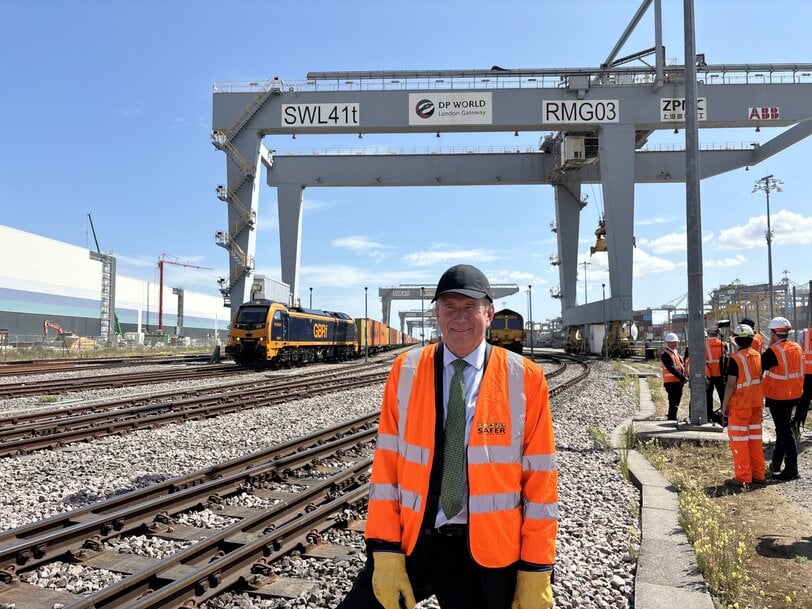
GB Railfreight (GBRf) has launched the first commercial service of its Class 99 hybrid freight locomotive, introducing a new generation of rail freight technology designed to lower emissions while maintaining operational flexibility across Britain's rail network.
The inaugural commercial service saw locomotive 99001 depart DP World London Gateway carrying intermodal freight to Maritime Transport's Hams Hall Rail Freight Terminal in the West Midlands. The service transports freight containers that can be transferred between rail and road without unloading cargo, supporting more efficient logistics operations.
The Class 99 locomotive has been developed to operate under electric power on electrified railway lines while switching to renewable-fuel-powered operation on non-electrified sections. This dual-mode capability enables continuous freight operations across the national network without requiring full rail electrification.
Hybrid Powertrain Supports Rail Freight Decarbonisation
According to GB Railfreight, the Class 99 is expected to reduce carbon emissions by more than 50% on a typical freight journey compared with conventional diesel locomotives. The design addresses one of the main challenges facing Britain's freight rail sector, where approximately 40% of the railway network is currently electrified.
By combining electric traction with renewable-fuel operation, the locomotive allows freight operators to lower emissions while continuing to serve routes that remain dependent on non-electrified infrastructure. Faster acceleration is also intended to improve compatibility with mixed passenger and freight operations, helping optimise network capacity.
The project represents more than four and a half years of planning, engineering and testing and was delivered through collaboration between GB Railfreight, Stadler, Beacon Rail and Network Rail.
Industry Partners Highlight Operational Benefits
GB Railfreight stated that the Class 99 combines lower emissions, improved operational performance and enhanced working conditions for train drivers while introducing a new generation of freight locomotives into commercial operation.
Maritime Transport noted that the locomotive's ability to operate under electric power where infrastructure exists, while continuing beyond electrified routes using renewable fuel, supports its strategy of increasing intermodal freight movements and integrating rail transport with its expanding electric heavy goods vehicle (eHGV) fleet.
DP World highlighted that increased use of rail freight from London Gateway can reduce road transport demand while making greater use of rail terminal capacity through more efficient and quieter locomotive technology.
Stadler described the Class 99 as an important development for reducing emissions in UK rail freight while maintaining the operational performance and flexibility required by freight operators.
Supporting Long-Term Rail Freight Growth
Rail freight contributes approximately £2.5 billion to the UK economy annually. The introduction of hybrid locomotives such as the Class 99 aligns with industry efforts to support the UK Government's objective of increasing rail freight volumes by 75% by 2050 while reducing transport-related carbon emissions.
The Class 99 provides an interim technological solution that enables emission reductions before nationwide railway electrification is completed, allowing freight operators to adopt lower-carbon traction across existing infrastructure.
Additional Context
This section details technical specifications and competitive benchmarking not included in the original product announcement
The Class 99 represents one of the first modern Co'Co hybrid freight locomotives designed specifically for the UK market. Compared with conventional diesel freight locomotives such as the Class 66, it offers electric operation on overhead-powered routes while retaining independent operation on non-electrified lines. Similar dual-mode freight locomotives are increasingly being introduced across Europe as operators seek lower-emission alternatives without relying solely on expanding electrified infrastructure. Manufacturers including Siemens Mobility, Alstom and Stadler have developed hybrid or dual-mode locomotive platforms to support freight decarbonisation, although technical configurations and power outputs vary depending on national railway requirements.
Edited by Sucithra Mani, Induportals editor – adapted by AI.
www.gbrailfreight.com
