
railway-international.com
29
'26
Written on Modified on
COMSA & CALAF Constructora complete new Calaf freight rail terminal
Terminal spans nearly 30,000 square metres with 4,200 metres of track and 1,800 metres of catenary, strengthening intermodal vehicle logistics.
www.comsa.com
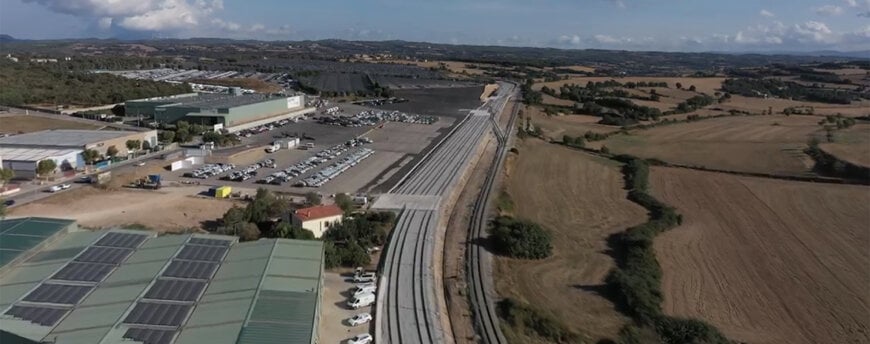
Infrastructure engineering specialists COMSA and CALAF Constructora partnered in a joint venture to build and commission the new Calaf Freight Rail Terminal for Autoflotas Automoviles y Servicios, S.L.U., establishing a dedicated intermodal logistics hub for the automotive transport sector.
Operational Challenge and Joint Delivery
Automotive logistics providers require direct rail links to shift vehicle distribution from road transport to intermodal rail corridors. Constructing dedicated private terminal facilities demands large-scale civil engineering, rail system installation, and precise interfaces with main rail corridors. COMSA and CALAF Constructora formed a joint venture to pool regional civil construction resources with specialized railway engineering capabilities, addressing the complex requirements of multi-track layout design, track laying, and traction power integration.
Technical Parameters and System Responsibilities
The joint venture constructed a handling platform covering nearly 30,000 square meters. The rail infrastructure consists of four internal handling tracks totaling approximately 4,200 meters of trackwork. To support electric traction, the installation included 1,800 meters of overhead contact line (catenary).
COMSA oversaw specialized railway systems and track installations, while the joint venture coordinated civil earthworks, slab foundations, and structural platform preparation. The facility integrates dual connection branches directly linked to the conventional Manresa-Lleida railway corridor, allowing freight trains to transition between main network operations and terminal loading tracks.
Active Network Integration and Engineering Scope
A critical engineering parameter was linking new turnouts and overhead electrification to an active railway corridor without disrupting scheduled rail operations. The joint venture coordinated four operational disciplines: civil engineering, track superstructures, overhead catenary electrification, and signaling-related rail systems. The physical connection required precise phasing of switch installations, sub-ballast stabilization, and overhead contact line tensioning to ensure complete compliance with operating safety criteria on the existing passenger and freight line.
Operational Impact on Automotive Logistics
The facility provides specialized handling capacity for finished vehicle transport, enabling rail operators to run block trains directly into the terminal. Shifting high-volume vehicle distribution onto rail reduces heavy road freight traffic, stabilizes transport transit times, and cuts operational emissions per ton-kilometer. The integration of internal tracks and overhead electrification supports efficient train turnaround times, shunting safety, and direct interoperability with regional freight networks.
Edited by Natania Lyngdoh, Induportals editor, assisted by AI.
www.comsa.com
