
railway-international.com
10
'26
Written on Modified on
Digital Railway Infrastructure And ETCS For Corridor Renovations
The Federal Ministry of Transport and DB InfraGO restructure corridor renovations to implement ETCS train control and stabilize the national railway infrastructure operations.
www.deutschebahn.com
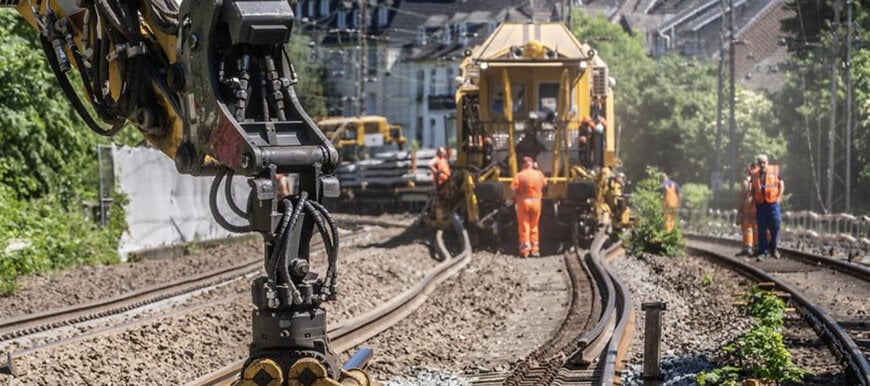
The Federal Ministry of Transport (BMV) and DB InfraGO have adopted a new 5-point plan to further develop corridor renovations in the German railway network. The technical and operational cooperation aims to stabilize construction and scheduling by purposefully pooling capacities and comprehensively integrating digital control and safety technology.
Capacity Management and Construction Planning
To relieve the scarce traffic capacities on the German railway network, the renovation volume between 2027 and 2031 will be reduced from the original 21 to 13 corridors. DB InfraGO is intensifying the provision of diversion routes and systematically coordinating the construction sequence with the rest of the network construction activities. This prioritization postpones measures with lower systemic benefits to complete the remaining construction volumes within the planned time and cost frameworks and to utilize the available resources of the construction industry more efficiently.
Standardization of ETCS Train Control
The technological modernization includes the mandatory preparation and installation of the European Train Control System (ETCS). Starting in the early 2030s, ETCS Level 2 without signals will be installed as standard in every corridor renovation. In the current transition phase, DB InfraGO is implementing ETCS-compatible interlocking systems, adapted signal locations, and modern axle counting technology to prepare the hardware for future retrofitting. On route sections such as Troisdorf-Wiesbaden and Rosenheim-Salzburg, the transitional technology ETCS Level 2 with signals is initially being installed.
Three-Phase Model and Gradual Commissioning
To minimize operational risks during the construction phase, DB InfraGO is introducing a three-phase model consisting of a preliminary, main, and follow-up phase. Complex work on the control and safety technology that does not require comprehensive operational closures will be scheduled before or after the main phase. The resumption of regular train traffic will occur gradually after construction is completed, beginning with load-testing runs by freight trains before passenger traffic is authorized. A dedicated commissioning team manages the transition into regular operations and addresses temporary defects directly during the first operating cycles.
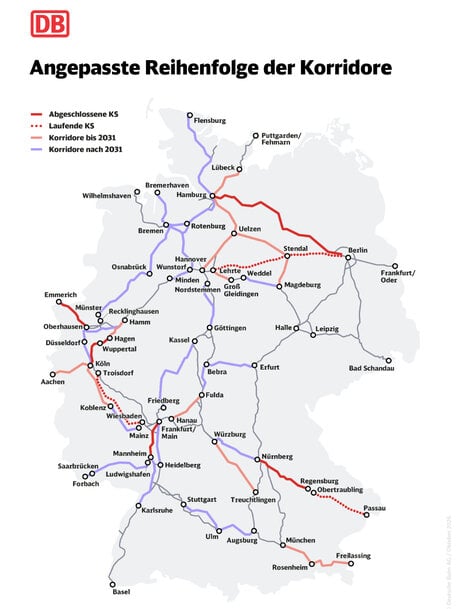
Operational Impact and Punctuality
The infrastructural adjustments aim for a measurable reduction in construction-related disruptions. After the completion of the renovation measures, infrastructure-related disruptions are expected to decrease by 80 percent no later than 100 days after commissioning. Reference data from the completed renovation on the Nuremberg-Regensburg route already demonstrates a decline in infrastructure-related disruptions of over 90 percent. The concept includes the requirement to keep the modernized routes largely free of major construction-related restrictions for up to ten years thereafter.
Edited by Maria Brueva, Induportals editor - adapted by AI.
www.deutschebahn.com
