
railway-international.com
10
'26
Written on Modified on
Battery Regional Trains Decarbonise Branch Lines Without Overhead Infrastructure
Lokaltog selects Stadler RS ZERO battery electric trainsets to eliminate diesel operations on the Danish Naerum branch line.
stadlerrail.com
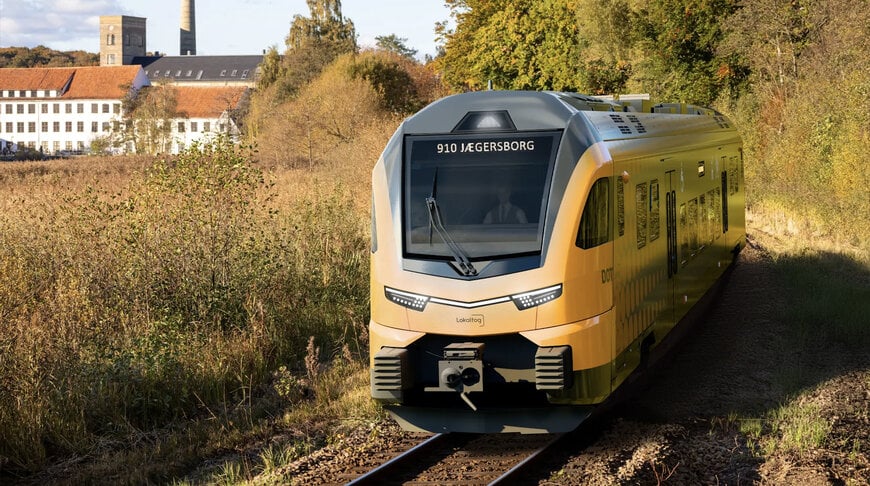
Non-electrified secondary rail routes present a distinct decarbonisation challenge where low traffic volumes cannot justify the capital expenditure of continuous overhead line electrification. To modernize these routes without costly civil infrastructure upgrades, Danish regional rail operator Lokaltog has selected Stadler to supply four RS ZERO battery-electric multiple units. The vehicles will be deployed along the 7.8-kilometre Naerum Line (Naerumbanen) between Jaegersborg and Naerum in the northern suburbs of Copenhagen, replacing existing diesel railcars to establish zero-emission passenger operations while lowering line-side noise and mechanical vibration.
Regional Rail Decarbonisation and Infrastructure Limitations
Branch line networks across Europe frequently retain diesel traction because conventional catenary installation requires heavy civil engineering interventions, bridge adjustments, and substantial capital funding. On short or isolated commuter alignments like the Naerumbanen, maintaining legacy diesel rolling stock incurs recurring maintenance expenses, local exhaust emissions, and acoustic disturbances in urbanized residential corridors.
The deployment of battery-electric multiple units resolves this trade-off by decoupling electric train performance from continuous wire infrastructure. On the Naerumbanen corridor, transitioning from diesel railcars to the RS ZERO platform is estimated to avoid approximately 800 tonnes of carbon dioxide emissions annually. Following required political approvals by regional councils, contract finalisation is scheduled for early 2027, with revenue service expected to commence during the first half of 2031.
Powertrain Design and Vehicle Architecture
The RS ZERO platform serves as the technological successor to the Regio-Shuttle RS1 vehicle family, which has accounted for approximately 500 operational diesel units across regional networks in Germany and the Czech Republic. Designed specifically for short-distance passenger corridors, the vehicle integrates proven battery and electric traction systems adapted from Stadler's broader alternative-drive portfolio into a compact railcar layout.
Manufacturing of the four trainsets will take place at Stadler's production plant in Berlin, Germany. The platform is engineered to navigate non-electrified routes by drawing traction power directly from onboard traction batteries. For the Naerumbanen deployment, charging and energy supply hardware will be provided in partnership with Swiss infrastructure specialist Furrer+Frey. This turnkey integration pairs train charging pantographs with localized stationary charging points, enabling fast turnarounds and reliable energy replenishment at line terminals without requiring full-route electrification.
Fleet Integration and Operational Strategy
The procurement expands Lokaltog's ongoing alternative-drive transition with Stadler in Denmark. Lokaltog previously ordered 24 larger FLIRT Akku battery trains, which are scheduled to enter commercial service between 2028 and 2029 across the Ostbanen, Tollosebanen, and Odsherredsbanen regional routes.
Ansgar Brockmeyer, Head of Marketing and Sales and Deputy Group Chief Executive Officer at Stadler, noted that numerous regional rail routes in Europe will remain without continuous overhead electrification. He stated that the RS ZERO provides operators with an economically viable technical solution to modernize such secondary lines sustainably while maintaining operational autonomy.
Additional Context:
This section details technical specifications and competitive benchmarking not included in the original product announcement.
Stadler first exhibited the RS ZERO prototype at the InnoTrans exhibition in Berlin in September 2024, presenting the vehicle in both battery-electric multiple unit (BEMU) and hydrogen fuel cell multiple unit (HEMU) configurations. A critical engineering parameter of the RS ZERO is its lightweight construction, achieving an axle load below 18 tonnes. This low axle load conforms to European route compatibility standards (such as EN 15528 Line Category C2 and lower), allowing the trainset to run across lightly laid rural and branch lines without requiring trackbed or bridge reinforcement. In pure battery configuration, the platform offers an operational range of up to 150 kilometres on a single charge and reaches a maximum design speed of 120 km/h, delivering maximum acceleration rates of up to 0.95 m/s².
Within the European alternative-propulsion regional train sector, battery rail vehicles have typically targeted larger two-car to four-car trainsets with higher passenger capacities and heavier axle configurations, such as the Alstom Coradia Continental BEMU, the Siemens Mireo Plus B, and Stadler’s own FLIRT Akku. These larger articulated platforms generally feature axle loads near or exceeding 18 to 20 tonnes, making them optimal for busier secondary main lines rather than low-density branch routes. The RS ZERO specifically targets the lightweight single-car and short-trainset branch line segment previously occupied by legacy diesel railbuses like the Siemens Desiro Classic, Bombardier Talent, and original RS1. In this segment, the RS ZERO competes directly against low-axle alternative solutions such as CAF's hybrid Civity and retrofitted battery railcars, distinguishing itself through purpose-built low-floor access, modular energy storage options, and integration with standardized terminal charging masts.
Edited by Natania Lyngdoh, Induportals editor, with AI assistance.
www.stadlerrail.com
