
railway-international.com
13
'26
Written on Modified on
HSL expands rail freight capacity to mitigate Rhine low water levels
The TX Logistik subsidiary is deploying double-unit traction to haul up to 4,000 tonnes of bulk goods per train from Amsterdam to the Rhine-Neckar region.
www.txlogistik.eu
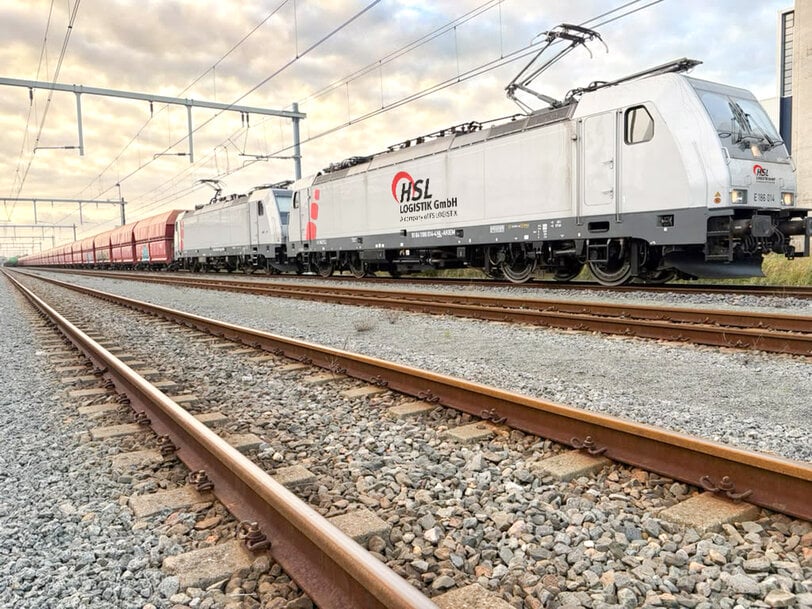
HSL, a rail transport subsidiary of TX Logistik (part of the FS Italiane Group), has rapidly established additional cross-border rail capacity to counter the severe supply chain bottlenecks caused by persistently low water levels on the Rhine River. Beginning in late October 2026, the freight operator stepped in to transport critical bulk goods, liquid fuels, and petroleum products between Amsterdam and the heavily industrialized Rhine-Neckar region, mitigating the severe loss of inland waterway shipping capacity.
Cross-border multi-system locomotives and heavy haulage
To manage the massive influx of displaced bulk freight, HSL has leased modern multi-system electric locomotives authorized for seamless cross-border transport. For exceptionally heavy loads, such as coal shipments, the operator is utilizing double-unit traction to haul up to 4,000 tonnes per train. According to Stefan Frankowski, Managing Director of HSL Logistik GmbH, these services are vital for maintaining the supply of raw materials to regional industries during environmental disruptions.
The emergency rail operations are initially scheduled to run for three months, with contingency plans for a three-month extension if the low water levels persist. Gian Paolo Gotelli, CEO of TX Logistik AG, emphasized that the rapid deployment demonstrates the immense potential of rail freight to provide stable, reliable supply chain solutions when natural environmental limits severely restrict other modes of transport.
Additional Context:
This section details the hydrodynamics of inland shipping and the physics of double-unit rail traction not included in the original press release.
Inland waterway logistics are strictly governed by Archimedes' principle of displacement. A river barge displaces a volume of water equal to its total mass. The vertical distance between the waterline and the bottom of the ship's hull is known as the draft. During severe droughts, the navigable channel depth of the Rhine drops significantly. To prevent the hull from scraping or grounding on the riverbed, operators must artificially reduce the vessel's draft. Because draft is directly proportional to payload mass, even a few centimeters of reduced water level can force a barge to operate at just 20% to 30% of its maximum cargo capacity, paralyzing bulk supply chains.
When this massive bulk volume is shifted to the rail network, it pushes train physics to the extreme. Hauling 4,000 metric tonnes of coal requires immense tractive effort (drawbar pull) to overcome static friction (starting resistance) and dynamic rolling resistance. A single locomotive cannot move this weight due to its adhesion limit—the physical coefficient of friction between smooth steel wheels and smooth steel rails. If a single locomotive applies too much torque to move 4,000 tonnes, the wheels will simply spin in place (wheel slip). By employing double-unit traction (physically coupling two locomotives and linking their computers via a multiple-unit control cable), operators double the number of powered axles. This distributes the massive mechanical torque across twice as many wheel-to-rail contact patches, increasing total adhesion and enabling the train to pull massive loads without losing traction.
Edited by an industrial journalist, Lekshman Ramdas, with AI assistance.
www.txlogistik.com
