
railway-international.com
16
'26
Written on Modified on
Alstom unveils first of 18 new Regio2N trains for Occitanie
The first train in the 18-unit order placed by the Occitanie Region in 2023 was unveiled in Narbonne by Alstom, SNCF Voyageurs and regional representatives.
www.alstom.com
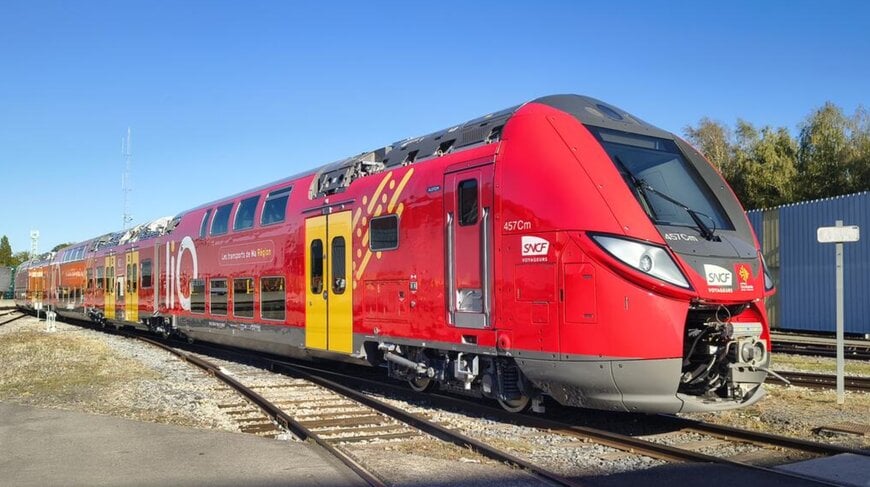
Regional rail networks across southern France face mounting passenger congestion along high-traffic intercity and coastal commuter corridors, particularly where existing station platform lengths restrict the operation of longer single-deck trainsets. Expanding passenger capacity without undertaking costly civil engineering modifications to lengthen station platforms requires high-density, multi-level rolling stock that maximizes seated capacity per meter of train length. At the same time, conventional double-deck regional trains often create boarding bottlenecks during peak station dwell times due to narrow entry vestibules and internal stairwells, hindering accessibility for passengers with reduced mobility, luggage, or bicycles. Resolving these operational constraints requires modular, articulated electric multiple units that pair high-capacity double-deck passenger saloons with wide-door, level-access single-deck boarding cars, while maintaining dual-voltage traction capability and modern European signaling compatibility across varied regional rail infrastructure.
Modular Articulated Architecture and Capacity Expansion
To relieve peak-hour crowding and increase regional seating capacity by approximately 40 percent, Carole Delga, President of the Occitanie Region, Jean-Aimé Mougenot, Managing Director of SNCF Voyageurs, and Benoît Carniel, Director of Alstom’s Tarbes site, unveiled the first of 18 new Regio2N trainsets in Narbonne on November 12, 2026. Ordered by the Occitanie Region in 2023 as an exercised contract option worth €223 million, the new rolling stock doubles Occitanie’s existing fleet of 18 Regio2N units. Assembled at Alstom’s Crespin manufacturing facility in the Hauts-de-France region, the 18-train fleet provides 18,000 additional daily seats tailored for the heavily traveled Toulouse–Narbonne–Montpellier corridor and the coastal line connecting Nîmes and Perpignan.
Derived from Alstom’s modular Omneo platform, the Regio2N employs an alternating layout of single-deck and extra-wide double-deck cars. The single-deck intermediate and end modules provide level boarding from standard 550-millimeter platforms through wide 1.6-meter double doors, improving passenger flow and step-free accessibility for travelers with reduced mobility. Inside, the extra-wide carbody profile accommodates wider aisles, ergonomic seating with individual power outlets, and dedicated storage zones for bicycles and luggage, complemented by open gangways that improve sightlines and passenger security. Across the broader Omneo range, trainsets scale from 81 meters (six cars) up to 135 meters (ten cars), equipped with three or four motor bogies for maximum operating speeds between 160 and 200 kilometers per hour under dual 1,500 V DC and 25 kV AC catenary electrification.
Delivery Schedule and French Industrial Footprint
Revenue passenger service for the newly unveiled trainset begins in December 2026 on weekend services between Toulouse and Nîmes, ahead of full daily deployment along the Nîmes–Perpignan coastal line starting in summer 2027. Under the agreed delivery schedule, Alstom will hand over the first 12 trainsets by March 2027, followed by the remaining six units in October and November 2027.
The Regio2N program forms a cornerstone of French rail manufacturing, holding the "Origine France Garantie" certification awarded by Bureau Veritas and the Pro France association. Accounting for roughly half of the industrial workload at Alstom’s Crespin plant, the program engages over 450 employees on site, 550 Alstom personnel nationwide, and approximately 300 suppliers across France and Europe. Under the overarching 2010 SNCF framework contract covering up to 860 Omneo trains, 567 units have been ordered across 10 French regions, alongside an additional 16 trainsets ordered for the Sud Region and Transdev.
Additional Context
This section details technical specifications and competitive benchmarking not included in the original product announcement.
In European regional electric multiple unit engineering governed by Technical Specifications for Interoperability (TSI) for Persons with Reduced Mobility (PRM TSI) and EN 15227 crashworthiness standards, the Omneo Regio2N distinguishes itself through an articulated double-deck architecture utilizing Jacobs bogies positioned between alternating single-deck and double-deck carbodies. Because French railway infrastructure imposes strict loading-gauge clearance profiles alongside dual-voltage electrification—comprising legacy 1,500 V DC overhead lines prevalent in southern France (including the Occitanie network) and 25 kV 50 Hz AC catenary in northern and high-speed-adjacent corridors—the trainset's roof-mounted traction chain integrates multi-system power converters and permanent-magnet synchronous traction motors. Housing heavy traction transformers, power electronics, and HVAC units on the roofs of the single-deck boarding modules frees the entire lower and upper decks of adjacent double-deck cars for passenger seating while keeping axle loads within regional track limits. Additionally, the new Occitanie trainsets incorporate dual-standard signaling hardware combining the legacy French KVB (Contrôle de Vitesse par Balises) speed-control system with the European Rail Traffic Management System (ERTMS), future-proofing the fleet for cross-border and modernized digital signaling corridors.
Within the European double-deck regional and intercity EMU sector, Alstom’s Omneo Regio2N benchmarks directly against competing high-capacity platforms from Stadler Rail (the KISS double-deck EMU family), Siemens Mobility (the Desiro HC, which similarly pairs single-deck end motor cars with double-deck intermediate trailers), and CAF (the Civity Duo and RER NG rolling stock). While Siemens’ Desiro HC places traction equipment inside single-deck end cars to simplify maintenance access and Stadler’s KISS utilizes full-length non-articulated double-deck carbodies with high distributed power for steep alpine gradients, Alstom’s alternating articulated module design optimizes wide-door dwell times and step-free 550-millimeter platform boarding within a compact 82.7-meter six-car footprint. This balance of rapid passenger exchange, dual-voltage 1,500 V / 25 kV capability, and modular interior customization has allowed the Omneo platform to establish a near-standard footprint across French regional transport authorities seeking to expand corridor capacity without lengthening station infrastructure.
Edited by Romila DSilva, Induportals Editor, with AI assistance.
www.alstom.com
