
railway-international.com
26
'26
Written on Modified on
Battery-Electric Trains Bring Regional Rail to Lithuania's Non-Electrified Lines
LTG Link puts the first Stadler FLIRT battery train into passenger service, running regional routes without overhead contact lines.
www.ltgcargo.lt
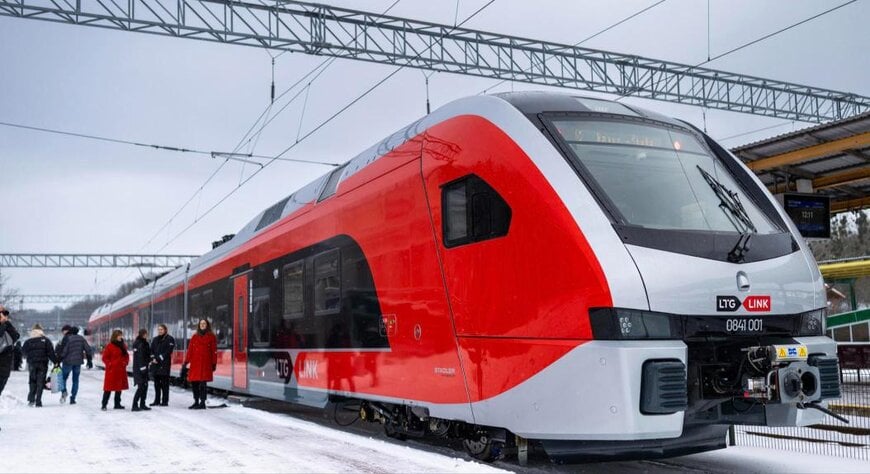
Lithuania's regional rail network includes long sections without overhead contact lines, where passenger services have traditionally depended on diesel traction. Battery-electric multiple units offer an alternative by drawing power from the catenary where it exists and from on-board traction batteries where it does not, allowing operators to run low-emission electric services across mixed electrified and non-electrified routes.
On 25 November 2026, LTG Link, the passenger transport company of the LTG Group, began carrying passengers on its first new-generation battery-powered Stadler FLIRT train, which departed from Šiauliai for Kaunas. The unit is one of 15 new trains purchased by LTG Link from Stadler as part of a fleet renewal programme that already includes electric FLIRT trains on electrified intercity routes.
Battery Traction for Mixed Electrified and Non-Electrified Routes
Unlike the electric FLIRT trains already in service, the battery-powered units can operate on both electrified and non-electrified railway lines. On electrified sections, the trains run from the overhead contact line, and on sections without catenary they continue on stored battery energy. This removes the need for diesel traction on regional routes that are only partly electrified and extends modern rail services to regions outside the overhead line network.
Route Planning and Charging Infrastructure
Battery operation is planned on three routes. Services between Kaunas and Šiauliai are the first to run, followed by the Radviliškis–Klaipėda–Radviliškis route at the end of November 2026 and the Vilnius–Varėna (Marcinkonys)–Vilnius route in mid-December 2026.
Range requirements differ by route. On the Kaunas–Šiauliai–Kaunas line, battery capacity is sufficient to cover the non-electrified sections without intermediate charging. For longer routes, trains arriving from Vilnius and Marcinkonys stop at a dedicated battery-train charging station in Varėna, the first facility of its kind in the Baltic states. Recharging takes around 15 minutes, depending on the battery's state of charge, which allows charging to be integrated into scheduled station stops on longer services.
Passenger Capacity and Accessibility
Each battery-powered train provides 128 seats. Seating and interior design are identical to the second-class carriages of the electric FLIRT trains, giving passengers a consistent environment across the fleet. The trains are adapted for passengers with reduced mobility, with ramps for step-free access, special lifts and accessible toilets. They are also equipped with self-service coffee and snack machines.
Fleet Modernisation on Lithuanian Railways
The battery units complement the new electric Stadler trains that entered service on the Vilnius–Kaunas–Vilnius route and, since 19 November 2026, on the Vilnius–Klaipėda–Vilnius route.
"Battery-powered trains enable us to provide high-quality transport services even on routes not served by the overhead line network, meaning more people in Lithuania will be able to use modern rail transport," says Kristina Meidė-Bertašienė, head of LTG Link.
Additional Context:
This section details technical specifications and competitive benchmarking not included in the original product announcement.
According to the International Railway Journal, LTG Link's first call-off with Stadler covers nine electric multiple units for intercity services and six battery-electric trains for non-electrified lines. Each battery train is more than 65 metres long and consists of three passenger coaches plus a dedicated power car housing the traction batteries. The trains are built for Lithuania's 1,520 mm broad-gauge network, and LTG Link described them as the first battery trains in Europe adapted to both harsh climatic conditions and broad-gauge railways. The FLIRT battery concept has already been demonstrated elsewhere: in December 2021, a Stadler FLIRT Akku set a Guinness World Record by covering 224 kilometres on a single battery charge during a dedicated record run. Other battery-electric multiple units follow a similar operating principle; Siemens Mobility's Mireo Plus B, for example, is specified with a range of up to 120 kilometres in its three-car version, with batteries recharged via the overhead contact line.
Edited by Natania Lyngdoh, Induportals editor, with AI assistance.
www.ltgcargo.lt
