
railway-international.com
31
'26
Written on Modified on
Implementation of Air Quality Control Technology for Railway Vehicles
A nanoe X generator jointly developed by JR East Technology and Panasonic Corporation has been adopted for Sagami Railway's new 13000 series trains.
holdings.panasonic
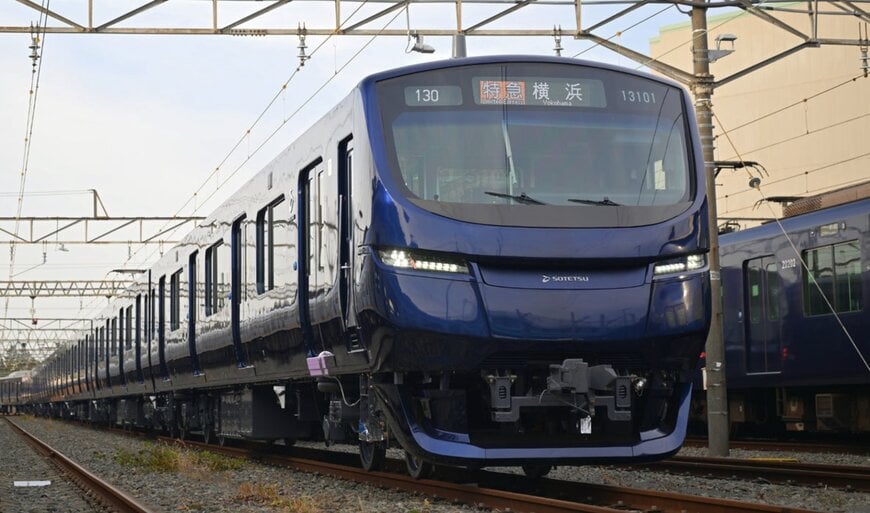
JR East Technology and Panasonic have developed a nanoe™ X generator optimized for railway vehicles. The system has been installed in Sagami Railway’s new 13000 series trains, which began operation on March 30, 2026, and has been introduced to improve the in-car air environment.
Air Quality Challenges Specific to Railway Vehicles
Inside railway cars, air frequently flows in and out due to door openings and passenger boarding and alighting, and the space is typically long and narrow. As a result, a key challenge for air quality control technology is ensuring uniform effectiveness throughout the entire cabin.
In addition, fluctuations in passenger density and the influence of outside air make it important to control distribution across the whole space in order to maintain stable deodorization and allergen suppression effects.
Overview of nanoe™ X Technology
Panasonic’s nanoe™ consists of nano-sized ion particles generated by applying high voltage to moisture, characterized by the presence of hydroxyl (OH) radicals. These active species act on odor components, bacteria, and pollen.
In nanoe™ X, the generation of OH radicals has been increased by approximately ten times compared to previous models, enhancing its air quality improvement performance.
Design Optimization for Railway Vehicles
In this system, JR East Technology has incorporated a control power supply unit suitable for railway applications into Panasonic’s nanoe™ X device, bringing the product to market.
This enables controlled ion diffusion tailored to the spatial characteristics of railway cars, helping to achieve more uniform air quality improvement throughout the cabin.
Implementation Track Record and Deployment
Sagami Railway has previously installed nanoe™ generators in its 20000 series and 12000 series trains. The new 13000 series marks the first adoption of the enhanced nanoe™ X version.
This deployment can be seen as a phased technological upgrade based on the operational performance of existing systems.
Implications for Railway HVAC Technology
Air quality control in railway vehicles requires integrated design across ventilation, air conditioning, sterilization, and deodorization functions. The application of nanoe™ X represents an example of combining conventional HVAC control with a chemical approach to air quality improvement.
Looking ahead, further technical challenges may include real-time control linked to sensors and achieving compatibility with energy efficiency requirements.
Edited by Romila DSilva, Induportals Editor, with AI assistance.
www.panasonic.com
