
Extending the Reach of Real-Time Monitoring
INGLAS is extending real-time geohazard monitoring beyond rockfall barriers, with a new sensor designed to monitor slope movement even in some of the most remote and challenging environments.
inglas.org
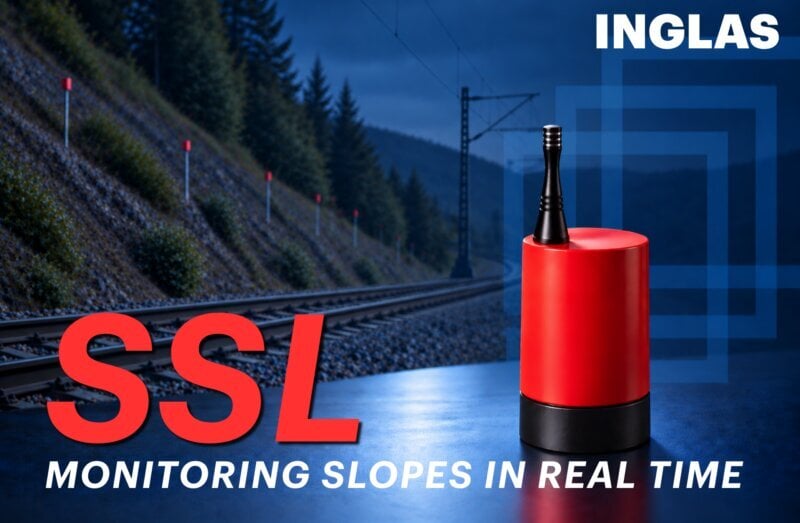
Landslides, mudflows and avalanches have always been an issue for rail asset owners and infrastructure operators, but the impacts of climate change have increased the threat of such events. Figures reported by the American Geophysical Union’s (AGU) digital magazine Eos, cite that in January and February 2026 alone there were 91 fatal landslides globally. This is above both the 2004–2016 long-term average and 2024, which was the previous worst year on record
.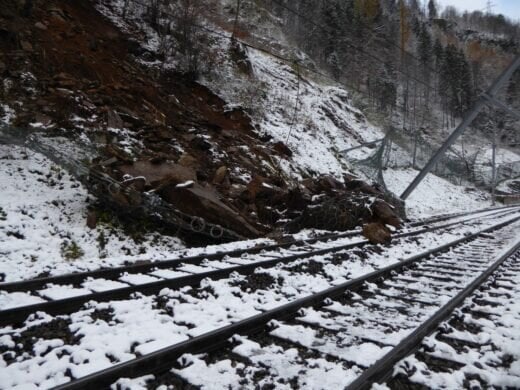
The SSL sensor is a standalone slope-monitoring sensor based on the same core capabilities as our ImpactSentinel™ sensor, which, as seen here, detected significant slope debris reaching a railway track in Switzerland.
© ImpactSentinel by INGLAS
More intense rainfall, freeze-thaw cycles and increasingly unpredictable weather patterns are putting increased pressure on slopes. Europe’s Alpine corridors are just one example of where the ongoing risk of such events is rising. Thawing permafrost strips out the ice that binds high-altitude rock and soil together, while heavier rainfall infiltrates already-weakened slopes and triggers failure. For infrastructure managers responsible for embankments, cuttings and tunnel approaches in these environments, this creates a growing need to understand what is happening on the slopes around their assets.
While the majority of rockfalls, landslides and avalanches can’t be avoided, real-time warning systems can improve how operators prepare and respond, enabling trains to be stopped, lines closed or safety systems activated before a situation escalates.
A Sensor for Every Slope
In response to the increasing frequency and year-round occurrence of geohazard events, INGLAS has seen a growing demand for reliable, continuous monitoring solutions that can be adapted to different environments.
Well-known for its ImpactSentinel™ rockfall barrier monitoring system, INGLAS is extending its offerings to include a new sensor for ground movement monitoring. The SSL is a high-precision, real-time monitoring sensor for detecting and monitoring movement in slopes, embankments and banks – any location where early detection of movement is important.
It has been designed to be used as either a standalone solution or to be deployed together with ImpactSentinel™ as a broader hybrid early warning system and uses the same communication pathways and gateway infrastructure. It was also developed with the same end goal in mind: to bring real-time monitoring to geohazard locations where installing conventional communications infrastructure can be difficult.
Monitoring Without Mobile Coverage
The SSL was designed to complement established inspection and asset management programmes by providing continuous, real-time information about ground movement at selected sites. It measures changes in the position and orientation of the sensor with the precision of 0.1 degrees and can be easily configured to suit the requirements of each location and installed without the need for an existing fence or barrier.
Instead, it can be mounted on a series of metal poles positioned across the monitored area, with the sensors communicating through a gateway via low-power sub-GHz radio communication. This ensures long-range communication while supporting low sensor power consumption and removes dependence on mobile coverage.
For areas without mobile coverage, the appropriate onward communication method from the gateway is selected according to site requirements, making it well suited to remote, rugged and difficult-to-access locations where conventional mobile/network coverage may be limited.
The Technology Behind the SSL
The SSL works by using six-axis MEMS sensing technology derived from the core technology used within ImpactSentinel™. A conventional inclinometer measures changes in angle or displacement, a seismometer or geophone measures ground vibration, and an extensometer measures linear displacement or changes in distance between two points. SSL’s six-axis MEMS core captures this range of movement within a single compact sensor, rather than requiring a separate instrument for each measurement type.
When movement exceeding the configured threshold is detected (typically 1°/S), the sensor then immediately transmits an event notification. In line with ImpactSentinel™, the alert time is under four seconds. This real-time reporting ensures managers are not only able to take action fast to ensure the safety of rail passengers, but also potentially limit the impact on their infrastructure by putting extra protections in place before a larger incident occurs.
Backed by a Decade in the Field
The SSL isn’t unproven technology finding its first application. It uses the same sensing core that has run within ImpactSentinel™ on the Gotthard corridor since 2010, and which held up through the 2024 Axenstrasse storm. Reconfigured for slope and embankment mounting rather than barrier monitoring, it carries that operating history into a new class of site.
While the requirement is global, INGLAS sees a particularly strong growing need for the SSL across Europe. As well as supporting managers with rail infrastructure in the Alps, it sees the UK’s rail network – one of the world’s most established and extensive, with embankments, cuttings and tunnel approaches across most routes – as a particularly strong opportunity for the SSL.
Release of this new sensor is expected in early 2027.
www.inglas.org
