
railway-international.com
17
'26
Written on Modified on
CBTC Signalling Automates Bengaluru Metro Pink Line Priority Section
Alstom has commissioned its communications-based train control signalling solution to enable Grade of Automation 2 operations on the Bengaluru Metro Pink Line priority section.
www.alstom.com
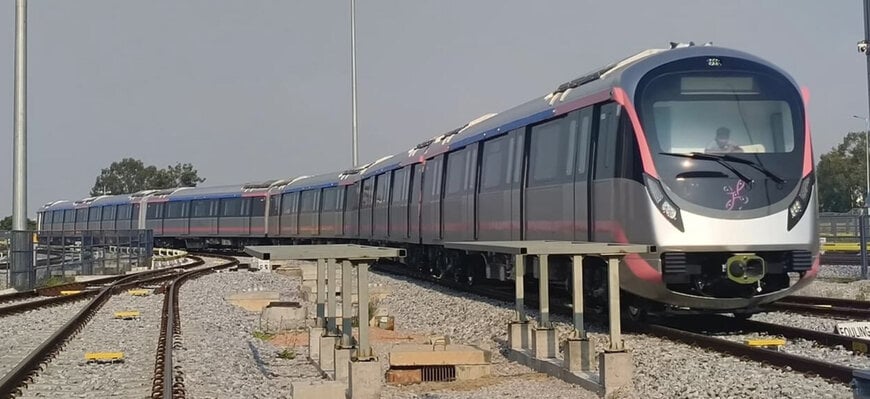
Rapidly growing urban transit networks face the challenge of increasing train frequency and passenger throughput on congested corridors without compromising operational safety. To address this requirement on Bengaluru's expanding metro network, Alstom has deployed its communications-based train control (CBTC) signalling technology on the newly opened 7.5-kilometre elevated priority section of the Pink Line Reach 6. Delivered for the Bengaluru Metro Rail Corporation (BMRCL), the system enables Grade of Automation 2 (GoA2) operations with automatic train operation (ATO) from the start of commercial service across six elevated stations in South Bengaluru.
Operational Mechanism of Grade of Automation 2 Signalling
Conventional fixed-block railway signalling divides tracks into rigid physical sections, limiting how closely trains can follow one another. In contrast, CBTC relies on continuous, bidirectional wireless communication between onboard train equipment and trackside infrastructure. This constant data exchange provides the control system with real-time, exact train positioning and speed profiles, allowing trains to run at shorter, dynamically calculated headways while maintaining strict safety margins.
On the Bengaluru Metro Pink Line, the system operates at GoA2. Under this automation architecture, the onboard ATO subsystem automatically manages train acceleration, cruising speed, and precision braking at station platforms. A train operator remains in the cab to oversee guideway conditions, manage door operations, authorize departures, and intervene during abnormal operating scenarios. Initiating commercial passenger service directly at GoA2 with active ATO marks a technical first for an Indian metro rail project.
System Architecture, Depot Integration, and Predictive Maintenance
The deployed signalling architecture encompasses main-line operations, fleet control, central supervision, and depot safety. The initial commissioning equips six trainsets serving six stations: Swagath Road, Jayadeva Hospital, JP Nagar 4th Phase, Indian Institute of Management, Hulimavu, and Gottigere. The Jayadeva Hospital station functions as a multi-corridor interchange linking the Pink Line with the Yellow Line.
Centralized traffic supervision is executed from the Operations Control Centre located at Baiyappanahalli in eastern Bengaluru using Alstom's Urbalis Vision platform. To maintain fleet availability and schedule adherence, the deployment integrates Alstom's HealthHub predictive maintenance platform. HealthHub continuously monitors the condition of wayside and onboard signalling assets in real time, enabling condition-based maintenance interventions that reduce unscheduled downtime and lower lifecycle operating costs.
Infrastructure integration extends to the Kothanur depot, which has been commissioned with automatic train protection (ATP) to enforce speed limits and safe routing during stabling and shunting movements. The depot also features an integrated test track equipped with ATO, allowing engineers to validate trainset signalling interfaces prior to main-line entry.
According to Olivier Loison, Managing Director of Alstom India, the deployment demonstrates the capability of CBTC signalling to support reliable and connected urban rail operations in Bengaluru.
Infrastructure Continuity Across Bengaluru Metro Phases
The Pink Line commissioning represents Alstom's third major infrastructure contract with BMRCL. Between 2009 and 2017, the company supplied the signalling and telecommunications systems for the 42-kilometre Phase I network covering the Purple and Green Lines. Alstom is also executing traction and power supply electrification works for Bengaluru Metro Phase 2. Globally, Alstom's CBTC portfolio spans more than three decades of development, with deployments selected for 190 metro lines worldwide and 18 lines completed or under execution across India.
Additional Context:
This section details technical specifications and competitive benchmarking not included in the original product announcement
In urban rail engineering, train automation levels are governed by the international standard IEC 62290-1, which defines five Grades of Automation ranging from GoA0 (on-sight manual operation) to GoA4 (unattended train operation without onboard staff). While GoA1 relies on manual driving supervised by ATP, GoA2 automates traction and braking under continuous ATP speed supervision. In global metro deployments, GoA2 represents an established operational baseline because it delivers the capacity, schedule regularity, and energy-efficiency benefits of automated speed profiles—as well as platform stopping accuracy within roughly 30 centimetres—while retaining onboard staff for immediate visual hazard detection and passenger management. Furthermore, moving-block CBTC architectures compliant with IEC 62290 and IEEE 1474 standards provide a standardized technical pathway that allows transit authorities to upgrade corridors toward driverless GoA3 or GoA4 operations in the future without replacing core wayside communications infrastructure.
Edited by Natania Lyngdoh, Induportals editor, with AI assistance.
www.alstom.com
